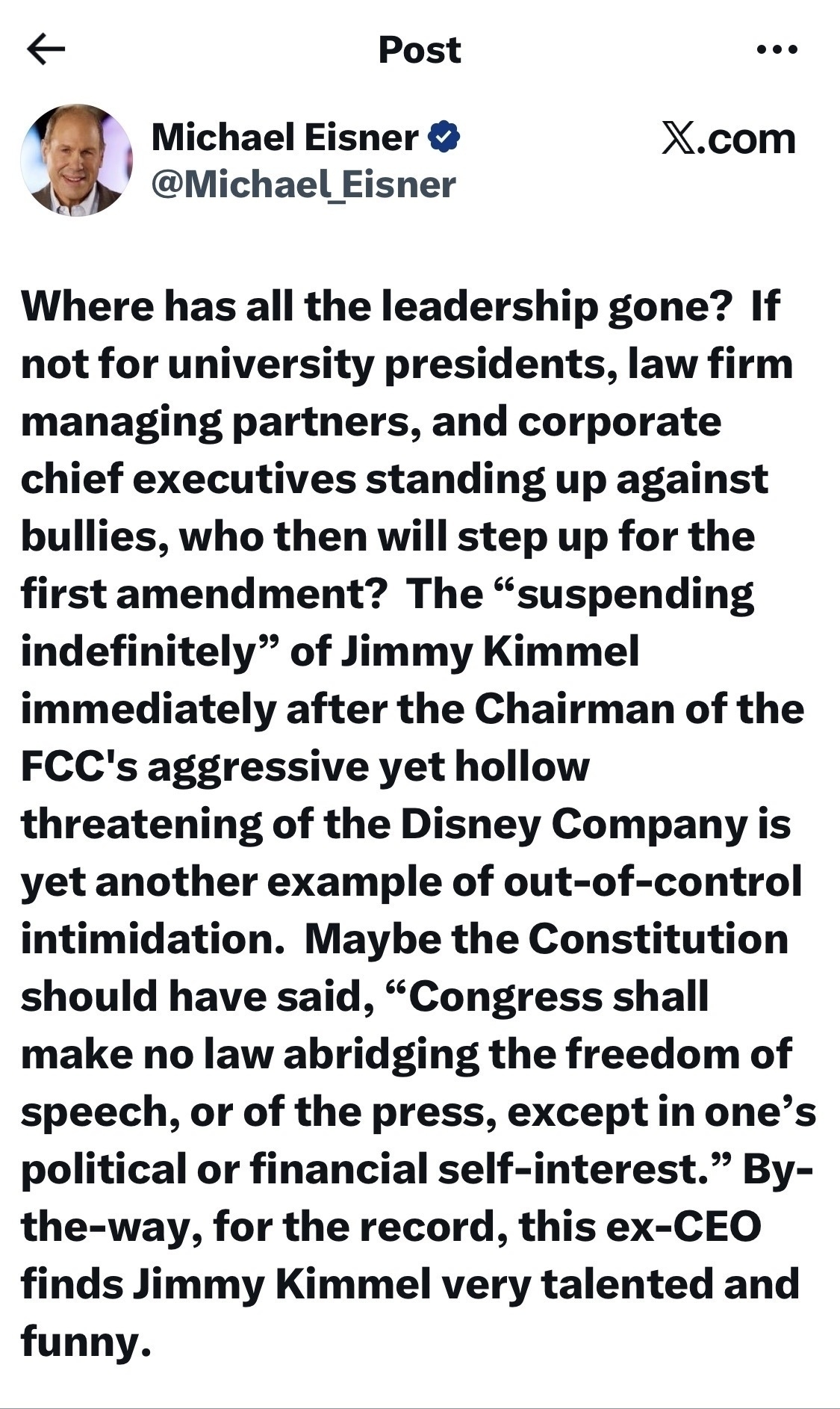
We’ll just leave this post from Michael Eisner below, so that if you hadn’t seen it yet, then you’ll know what we are talking about, because this actually carries more weight than anything we could possibly say about the situation.
Also, anyone else notice that Pittsburgh’s ABC affiliate, WTAE (owned by Hearst), apparently is not running the fill in programming for “Jimmy Kimmel Live” from the network, but is doing a one hour late newscast at 11pm, then airing their local show “4 The Record” at 12:05 am—and then finally rejoining the network for “Nightline” at 12:35am?
Let’s make our view clear right off the top. We have arrived at a fraught moment in our nearly 250-year experiment known as democracy.
We are in the wake of a terrible act of political violence. From what we know as of writing this, a lone gunman decided to take the life of an outspoken and controversial political figure as he was speaking on the campus of a Utah university last week. In the days that have followed, the rhetoric on nearly all points of the political spectrum has been supercharged by social media platforms that actually profit from a lack of civil discourse, antagonized by anonymous agitators and egged on by autonomous bots from hostile actors.
With little hard evidence or proof of any real substance, each side has accused the other of somehow being responsible for the single shot that ended Charlie Kirk’s life. And that act requires this simple declaration: no matter your opinion of the man’s words, he had the absolute right to express them, without fear or threat to his life, liberty, or pursuit of happiness.
He had the same guarantee to that right as every Man, Woman, or Child in this country. The founders of this nation said so in The Declaration of Independence:
"We hold these truths to be self-evident: that all men are created equal; that they are endowed, by their Creator, with certain unalienable rights; that among these are life, liberty, and the pursuit of happiness."
There is absolutely no pretense that can be a justification in any way for the assassination of Charlie Kirk. Nor is there one for the assassination of Minnesota State Representative Melissa Hortman and her husband in June. Both killings are equally heinous and should be resoundingly denounced by all. The perpetrators should be prosecuted to the full extent of our justice system and subject to the maximum penalty if found guilty of those crimes.
Civilized people should not debate this. We can and should debate policy, big and small. We can challenge each other on ideas and beliefs. We can practice real citizenship, defending the rights of those with whom we disagree the most. Their equality requires the right to express their views, thoughts, and beliefs, even when they differ entirely from our own. But democracy demands that they defend our equal rights as well.
The Bill of Rights of the U.S. Constitution spells this out rather clearly in the First Amendment:
"Congress shall make no law respecting an establishment of religion, or prohibiting the free exercise thereof; or abridging the freedom of speech, or of the press; or the right of the people peaceably to assemble, and to petition the Government for a redress of grievances."
Freedom of Religion. Freedom to Worship. Freedom of Speech. Freedom of the Press. Freedom to Assemble and Protest in a peaceable manner.
Those things are bedrock to our democracy. No one person or the many elected to represent us can deny these rights. Our nation has fought wars over these rights, both on our own soil and that of other nations. Two of those wars were large enough to be called World Wars. Too many of those who have worn our country’s uniforms in military service have made the ultimate sacrifice to secure these rights.
Free Speech and a Free Press are two hallmarks of our democracy. Our founding fathers could not have conceived of the Internet. They couldn’t have conceived of “the media” much beyond the printing press back when the Bill of Rights was ratified in 1791. It would be nearly 100 years more before Edison made the electric light bulb practical. Then, 40 more years passed before the first commercial radio broadcast. And 20 more years before television.
Congress would constitute an agency to regulate the newly found airwaves "in the public interest, convenience, or necessity." Originally called the Federal Radio Commission, the Federal Communications Commission would succeed it under the Communications Act of 1934. The Commission’s purview has been expanded over the years to oversee all communications by radio, television, wire, internet, Wi-Fi, satellite, and cable across the United States.
But it is Broadcasting, the operation of the nation’s radio and television stations, where the FCC has unique authority. Because of the fundamental idea that the broadcast spectrum is a finite resource, the FCC licenses all radio and television stations. It has always required that broadcasters operate “in the public interest.” The process of obtaining and renewing a broadcasting license requires proof that a broadcaster demonstrates how their services meet the needs of the communities in which they operate.
Other than regulating content deemed to be obscene or unlawful in some manner, the FCC has typically not told broadcasters what content should be in the programs they air. Even the doctrine that required political balance in broadcast programming was removed in 1987, when the FCC determined that its own “fairness doctrine,” which had been in place since 1949, had “a chilling effect on free speech.” The FCC’s move came after Congress passed a bill to codify the fairness doctrine into federal law. President Ronald Reagan then vetoed the bill, calling it “antagonistic to the freedom of expression guaranteed by the First Amendment."
Fast forward to September 17th, 2025. The current chairman of the FCC, Brendan Carr, made this declaration on Fox News: “We at the FCC are going to force the public interest obligation. There are broadcasters out there that don’t like it, they can turn in their license in to the FCC,” Carr said. “But that’s our job. Again, we’re making some progress now.”
The progress that Carr is referring to is that earlier in the evening, the ABC television network announced it was suspending indefinitely the production and airing of its late-night show “Jimmy Kimmel Live.” The network took the unprecedented step following growing criticism over this comment made by host Jimmy Kimmel on Monday night’s show: “We hit some new lows over the weekend with the MAGA gang desperately trying to characterize this kid who murdered Charlie Kirk as anything other than one of them, and doing everything they can to score political points from it."
FCC Chairman Carr joined a backlash of growing criticism of Kimmel, primarily from the right, in an interview on Wednesday. That’s when he told podcaster Benny Johnson that Kimmel’s remarks were “a concerted effort to lie to the American people.” Carr went on to not so subtly threaten the nation’s broadcasters directly, stating, “these companies can find ways to change conduct and take action, frankly, on Kimmel, or there’s going to be additional work for the F.C.C. ahead.”
Shortly after Carr’s remarks were released, the nation’s largest television station owner, Nexstar, told ABC that 32 of its stations, which are ABC affiliates, would be “preempting” Kimmel’s TV show for the foreseeable future.” As the taping for Wednesday night’s edition of “Jimmy Kimmel Live” was about to get underway in Hollywood, CEO Bob Iger and Television head Dana Walden of The Walt Disney Company, which owns ABC, made the decision to suspend the program, according to reporting from The New York Times.
Kimmel’s remarks were seen differently by Anna Gomez, the lone Democratic appointed commissioner on the FCC. She told CNN’s Erin Burnett in a Wednesday night interview: “I saw the clip. He did not make any unfounded claims, but he did make a joke, one that others may even find crude, but that is neither illegal nor grounds for companies to capitulate to this administration in ways that violate the First Amendment,” Gomez went on to say, “This sets a dangerous new precedent, and companies must stand firm against any efforts to trade away First Amendment freedom.”
By later Wednesday evening, another large owner of ABC affiliates, Sinclair Broadcast Group, weighed in and said that it had told ABC before it announced it was suspending Kimmel’s show that it would also be preempting the program across its ABC-affiliated stations. Sinclair also said it planned to replace Kimmel’s program this Friday night with a one-hour tribute to the late Charlie Kirk.
We couldn’t help but remember when Sinclair pre-empted a special edition of ABC’s “Nightline” back in 2004. The Nightline special called “The Fallen” featured host Ted Koppel reading the names of the 700-plus U.S. servicemen and women who had died in Operation Iraqi Freedom. Sinclair said at the time that the program “appears to be motivated by a political agenda to undermine the efforts of the United States in Iraq.” History would note that the primary motivation for Operation Iraqi Freedom was to disarm Iraq and its leader, Saddam Hussein, of “weapons of mass destruction.”
A reminder that no such weapons were ever located.
It should be noted that both Nexstar and Sinclair have business reasons to heed the intent of the comments made by FCC Chairman Carr. Nexstar will likely need FCC approval to acquire major broadcast group owner Tegna, announcing its intention to do so just one day after a news report stated that Sinclair was proposing its own merger with Tegna. Either deal would be worth billions of dollars, and the FCC's most recent experience in “slow walking” the Paramount-Skydance deal shows that the commission can make it significantly more challenging to get a deal done in the media world now.
At the end of the day, we certainly acknowledge that broadcasters have the authority to determine what they air on their stations. They alone are responsible for the federal licenses that allow them to be in business. Networks are also free to decide on what they produce and distribute to their affiliates. These are businesses that have the right to operate as they see fit. But audiences also have the right to watch what they want to, and last we checked, every screen comes with both a way to change what is shown on it--or even to turn it off, if so desired by the viewer.
History will be the ultimate judge of the wisdom of the decision to take Jimmy Kimmel off the air, for however long that might be. But ABC’s decision doesn’t mean that he will be off for good. Given the state of the media universe and the choices available to viewers, it is likely that there will be ways for him and competitor Stephen Colbert to appear on other platforms after their network contracts end.
Because these days, A.J. Libeling’s 1960 quote "Freedom of the press is guaranteed only to those who own one” has a very different context, especially in a world where almost anyone can have their own TV show that can be seen by millions.
The FCC Chairman told Sean Hannity on Fox News Wednesday night that “This is an important turning point."
We suspect that he has no idea just how big of one it might actually turn out to be.
Robert Redford, the prodigious award-winning actor, director, and producer, passed away earlier today. Redford’s long Hollywood career, which developed initially as a television actor in the beginning of the 1960s, would lead to him breaking into movies with 1965’s “Inside Daisy Clover” and continuing as a leading man until 2018’s “The Old Man and the Gun.” He would also work behind the camera, beginning in 1980, to become a renowned director with his debut with the film “Ordinary People” for which he won the Oscar for Best Director in 1981. Redford was also a prolific producer and, along the way, found time to champion the development of the Sundance Film Festival.
The obvious place to start is the movie adaptation of Bob Woodward and Carl Bernstein’s book, “All The President’s Men,” which chronicled their reporting of the Watergate scandal that led to the resignation of President Richard Nixon. Redford would play Woodward, who had the contact with the anonymous source called “Deep Throat” who fed the reporters, and ultimately The Washington Post, the missing pieces of the story of the cover-up of the break-in of the offices of the Democratic National Committee. These key tips from the source who revealed himself in 2005 were from Mark Felt, a Deputy Director of the FBI, who helped unravel the largest story of a political cover-up in the nation’s history.
At least it was at the time.
Redford’s leading man looks were questioned as being perhaps “too pretty” to portray Woodward, playing opposite a Dustin Hoffman who bore a bit more of a resemblance to reporter Carl Bernstein. But Redford delivered a strong performance in the role, even though neither he nor Hoffman was nominated for an Oscar. Their co-star, Jason Robards, was nominated and won the Oscar for Best Supporting Actor for his razor-sharp portrayal of Post publisher Ben Bradlee.
For our money, “All the President’s Men” is one of the best movies about the work of journalism, and a pretty dramatic behind-the-scenes look at the process that uncovered the conspiracy that led to the end of the 37th presidency. As with many movies, the original book provides a more detailed account of the story behind the story, while the film remains largely faithful to the narrative of the reporting duo.
For his part, Redford stated that he felt like the film was about more than Richard Nixon’s downfall. The actor said he was drawn to the movie because “It’s about investigative journalism and hard work.” Redford noted on more than one occasion that he believed the film was necessary to remind people of "the power and importance of the press. In 2006, on the thirtieth anniversary of the film, Redford told NBC’s “The Today Show” that “Accuracy was the big, big objective.” Many people were unaware that Redford himself had initially approached Woodward and Bernstein while they were still writing the book about the idea of turning their story into a movie. He recounted that the prevailing opinion in Hollywood was that “No one cares, and no one wants to see this."
Redford would become a co-producer of the seminal film and felt that its message was still relevant to the state of politics some three decades later. He believed similar developments were happening during the administration of President George W. Bush, telling “The Today Show” in 2006: “Watergate is happening every day, it’s pretty transparent. It’s not something you have to reach for or exaggerate."
The intersection of the movies and journalism would come again in another Redford movie, some 20 years after “All The President’s Men."
In 1996’s “Up Close and Personal,” Robert Redford plays a local television news director who discovers and mentors an attractive and eager young reporter played by Michele Pfeiffer., The movie follows her professional rise through the business of TV news. But this being Hollywood and all, Redford and Pfeiffer’s characters fall for each other, and their relationship is the thread that ties the acts of the movie together. The portrayal of the drama when Pfeiffer’s character unseats the experienced female news anchor played by Stockard Channing may be the best scenes in this soapy cinematic look at the “rough and tumble” world of TV news.
But the source material for “Up Close and Personal” was, in part, based on the story of real-life TV news anchor Jessica Savitch. Savitch’s life was chronicled in the 1998 book by Alanna Nash titled “Golden Girl.” The book detailed the meteoric career of Savitch, who went from an administrative assistant at New York’s WCBS Radio in 1969 to getting a first job as a TV reporter in Houston at KHOU. She would then move to Philadelphia’s KYW as a reporter and weekend anchor in 1972, while working for news director Jim Topping. Savitch would move into the main weekday anchor role opposite co-anchor Mort Crim, and she became a major celebrity in Philly. She would join NBC News in 1977, where she would later become the second woman (after Catherine Mackin) to anchor a national network newscast.
If Pfeiffer’s character in the movie was based somewhat on the real-life story of Jessica Savitch, then Redford’s TV news director character was likely based in part on the real-life character of Ron Kershaw. A later book about Savitch from 1989, titled “Almost Golden - Jessica Savitch and the Selling of Television News” by Gwenda Blair, details the intermittent and often stormy relationship between Savitch and Kershaw over the years. Kershaw was a local television news director in Chicago, Baltimore, and New York City’s WNBC-TV, where he is credited with turning that station’s fortunes around and creating the breezy newscast titled “Live At Five."
Kershaw died from pancreatic and liver cancer in 1988. Savitch died earlier in 1983, in a bizarre auto accident with Martin Fishbein, a VP with the New York Post, whom she had been briefly dating. The car, driven by Fishbein, took a wrong turn in a storm and landed in a canal. Both Fishbein and Savitch drowned in the vehicle, which went off the road into the water, then sank into heavy mud and was filled with water.
Needless to say, the ending of the movie “Up Close and Personal” is quite different, though still melodramatic, as befitting a Hollywood movie.
Update: After we originally published this column, one of our favorite colleagues and a loyal reader of “The Topline” pointed out a third intersection of Redford’s acting career with journalism that we totally forgot about. Redford played the role of CBS Anchor Dan Rather in the 2015 movie “Truth.” Co-starring with Cate Blanchett as Rather’s real-life producer Mary Mapes, the film explores the events surrounding Rather’s controversial report for “60 Minutes II” in 2004, questioning the circumstances of President George W. Bush’s military service in the National Guard. The massive criticism of the reporting ultimately ended the careers of both Rather and Mapes. She resigned shortly after the report aired. Rather retired two months later. Mapes wrote the book on which the movie was based, and both she and Rather participated in the production of the film. For its part, CBS did not cooperate with the production and put out a statement at the time the movie was released that it was “astounding how little truth there is in “Truth.”
We regret missing this third film with Redford as a journalist, and you can be sure we’ll be watching it in the coming days.
Of course, by 2015, Robert Redford had already made a long string of major motion picture classics such as 1973’s “The Way We Were” with Barbra Streisand, 1975’s spy thriller, “Three Days of the Condor”, 1984’s ode to baseball, “The Natural” and 1985’s stunning “Out of Africa” just to name a few titles from Redford’s extensive filmography. His two pairings with the legendary Paul Newman, notably in 1969’s “Butch Cassidy and The Sundance Kid” and 1973’s “The Sting,” are perhaps two of the movies he will be most remembered for. The latter role in “The Sting” earned him the Oscar for Best Actor.
But Redford’s three dramatic turns as a newsman will be personal favorites of ours. If you haven’t seen either lately (or at all), we’d suggest you add them to your watch list for a viewing in the near future.
And as any good obituary should end, Robert Redford died early today at his home in Utah of unspecified causes. He was 89 years old.
Anyone who has worked in television for more than a minute or so learns that there are three sets of numbers that you have to care about.
The first are the ones that appear on your paycheck. Working in television is a job, and while your internal motivation for choosing this business may vary, we are pretty sure the main reason is that, like anyone, you would like to be paid for your work. (Last time we checked, we didn’t find that anyone was being forced to work in this industry.)
And as a person working in television, the second set of numbers that you should care about are the ones that you likely will never see. Those numbers would be the ones on the profit and loss statements that your employer generates each month, quarter, and year. Contrary to the belief of some, television is still a for-profit business. If your employer isn’t making any money — and continues for a period of time — it is probable that you won’t be making money from them at some point in the future.
Finally, the third set of numbers that you should care about are what are usually referred to as simply “The numbers.” And those digits would be the ratings. More formally known as the measurement of the audience watching your station (or show, group, or network, as the particular case may be). The ratings are, simply put, the report card on what is shown on television at any given time. That report card can be issued as soon as the next day, or in some cases at the end of the month, or the end of a season—depending on the time period being measured.
Why ratings matter is that they determine how much your outlet can charge advertisers to run commercials on the station, so they directly determine a station’s bottom line numbers (the second set mentioned above), which in turn directly impacts the money your outlet has available to put into your paycheck (the first set we previously mentioned).
Much like your report card back in school, learning the ratings is how we all measure who is winning and who is losing. And not unlike the marks you received on your school report card, the numbers in the ratings can determine the future of your employer and ultimately, you.
Ratings come from two companies that exist in the industry. The proverbial 800-pound gorilla is, of course, Nielsen, a company that traces its roots back to radio in 1923. Originally known as The A.C. Nielsen Company, it has been the primary provider of ratings, first for radio, and later for television, over the course of its 100-plus-year history. The company has evolved from a methodology of asking a statistically representative number of people in the audience (known as “The Sample”) to record their viewing over a period of time, through the use of technologies that have evolved over the years. In the beginning, Nielsen asked viewers to keep a written record of what they watched (a “diary” of their viewing) over a period of time. Over the years, the same kind of discrepancies found in the testimony of “eyewitnesses” to events, led the company to develop technoloiges like the “Audiometer” and more recently the “People Meter” to make the process of accurately recording what viewers in the sample watched an automatic one that didn’t rely on anyone’s memory or their diligence in writing and mailing a paper record.
In 1949, Nielsen got a competitor in providing television ratings information. The new company was called the American Research Bureau or ARB. It would later change its name to Arbitron. In the mid-1960s, Arbitron began focusing exclusively on providing radio ratings, in part because of the larger number of radio markets and station clientele available. Some would suggest it was also motivated by the dominance of Nielsen in providing ratings for television. Ultimately, Arbitron would leave the television ratings business and focus only on radio. In 2013, it was acquired by Nielsen and is now known as “Nielsen Audio,” operating as the company’s radio ratings division.
It wouldn’t be until 1999 that another competitor to Nielsen would emerge. That year, a company called “Comscore” would begin using the still-emerging digital technologies around the internet to provide audience measurements for both digital and TV programming. It now bills itself as a “global provider of digital intelligence and cross-platform measurement.”
Today, the business of providing audience measurement and ultimately “ratings” is a case of a small company (Comscore) competing against the dominance of the larger and older player in the space, that being Nielsen.
And yet, for as dependent as the television industry is on the measurement of the number and demographic breakdown of the viewers, the reality is that no available measurement and reporting of those viewers is without flaws and serious questions, which has left an uneasy relationship between those who produce and distribute television shows and those who make and distribute the audience data that drives most every other part of the television industry.
So when that most important of television programming, a National Football League game, recently appeared for the first time on the 800-pound gorilla of the streaming space (Google’s YouTube), the most asked question was, of course, “How many people watched?” Thus, the ratings for that particular television program would immediately be seen as a report card on streaming’s ability to deliver a football audience that was once the exclusive domain of traditional broadcast and cable television.
And Nielsen dutifully delivered the answer. YouTube had delivered its inaugural football contest to approximately 17 million viewers.
But a week after the game, YouTube said that the audience estimate was being adjusted upwards by about 2 million viewers, making the total nearly 20 million viewers.
Much like in a football game, when the replay officials change the original call, the folks in charge of analyzing the data at both Fox Sports and Disney threw their own red flag to challenge the ratings of the YouTube-delivered game. They claim that Nielsen created a special version of the method to measure the audience.
This is not the first time Nielsen has been accused of something similar to the notion that George H.W. Bush used when he described Ronald Reagan's economic strategies back in 1980 as “voodoo economics.” (That term would later be part of a hilarious scene in the movie “Ferris Bueller’s Day Off” when it was part of a lesson being taught by a high school teacher brilliantly played by actor Ben Stein.)
The “voodoo economics” of television ratings centers around just how a relatively small sample of television viewers can accurately reflect the actual behavior of millions of television viewers. And given the vital importance of the ratings to the television industry—especially at this crucial juncture when the very nature of how people are (or aren’t) watching television is fundamentally changing—the trust in the accuracy of those ratings is no small thing.
For years, those of us who have worked in television have had our work judged by “the numbers” which television networks, stations, advertising agencies, and others spend a small fortune to obtain. In recent years, some local broadcasters have pushed back on Nielsen’s near monopoly in the ratings game, with some going so far as to drop the service for a period of time and either use Comscore’s ratings (which have their own potential shortcomings) or operate with no ratings numbers at all.
The various questions about the accuracy of Nielsen ratings have usually been swept aside by the assertions of the industry’s association that accredits audience measurement services, known as the Media Rating Council. This non-profit group oversees the standards and independent auditing of the ratings services, namely Nielsen and Comscore, along with newer digital upstarts such as VideoAmp and iSpotTV. The MRC gives ratings services their accreditation credential, which is meant to assure users of the accuracy of the ratings data provided by a given service.
In 2021, the MRC found that Nielsen undercounted viewers during the COVID-19 pandemic and took the dramatic step of temporarily suspending Nielsen accreditation. Just this past January, the MRC gave its approval to Nielsen for their new method of analyzing the data of audience viewing from “45 million households and 75 million devices.” This new measurement is known as “Big Data + Panel TV.” Nielsen’s CEO dutifully said at the time: “I believe Big Data+Panel gives the industry the most accurate measurement in the history of TV.”
Well, we’re certainly glad that it has only taken 75 years to get to this point.
You know, where the entire business is based on numbers that somehow still feel like…(remembering Ben Stein’s monotone voice from the movie now) “Anyone…anyone? Something... D-O-O economics?"
The dust-up over the Nielsen ratings for the inaugural NFL game on YouTube will likely settle down as these things always seem to do. After all, the co-dependency relationship between Television and the Ratings isn’t about to end, because each has too much invested in the other. And, as is often the case in such situations, even with the current reality which includes technology that can identify whatever you are doing online and deliver you an ad for that thing you were first thinking about just a few minutes ago, the TV ratings are still, as one station executive said to us years ago, "pretty much the only game in town."
We’ve been talking with some people over the past few weeks about our nagging feeling that the new owners of Paramount, David Ellison’s Skydance Media, which is now trading under the new stock ticker PSKY, could have aspirations to do more than just “right-sizing” CBS News and Stations, which is the division of Paramount that operates the Network News division and the Owned Stations group. (That interesting divisional structure was created under the previous regime of Wendy McMahon.)
And we said, out loud, and more than once, that we could see CBS News being a potential acquirer of the now semi-struggling CNN. It makes perfect sense, really. CBS is still a major news network here in the United States, despite whatever is going on with the leadership of the newsroom. And CNN is still a major international force in news for the rest of the world. Combining the two could create a global news giant to rival the BBC in many ways.
What we didn’t think was that PSKY would make a bid to swallow the whole Warner Bros. Discovery empire. But this afternoon, the Wall Street Journal reports that this is precisely what might happen. (Hat tip to TheDesk.Net for sending us the first alert on the story.)
Though details are slim in the early story, it seems based on substantial reporting that Paramount is preparing an all-cash offer that could lead to the putting of two major movie studios (Warner Brothers and Paramount) under the same roof, along with a broad spread of television brands from CBS and CNN to MTV and Discovery. Not to mention two significant digital streamers of Paramount+ and HBO Max, along with the free streamer PlutoTV.
It is a potentially massive media deal that, if true, would require significant government approval from the Federal Trade Commission. But, curiously, there would be no obvious clearance needed from the Federal Communications Commission, because Warner Bros. Discovery has no broadcast properties and therefore no license transfers that would need to be approved by Brendan Carr and company. (Not that they might not have something to say about the deal just the same.)
So now we are thinking, is there even more on PSKY’s potential list of acquisitions?
After all, David Ellison’s father, Larry Ellison, the CEO of Oracle, became the richest man in the world yesterday with a worth of about $393 billion.
And we hate to use the clichéd tag here, but this is certainly a breaking story and we’ll have more for you... as it develops.
As has been the case for many years now, yesterday, Apple CEO Tim Cook welcomed everyone to the company’s uber-futuristic headquarters in Cupertino, California, to get the first look at the latest and greatest versions of what the company has to offer.
If you haven’t seen it, it is worth the time to watch. Here is a link you can click to do so. (And if you are really busy and pressed for time, the folks at The Verge have a streamlined version of all the key highlights available here.)
You have to hand it to the folks at Apple. The annual introduction of the new iPhones, Apple Watches, and AirPods is a significant enough event that it gets covered as a major news story. And not just in the tech-oriented press. The instant impressions of the strengths and weaknesses of the new devices were being reported on as closely as the latest economic figures to come out of Washington.
And with good reason. No matter what the initial reviews might say, the fact is that Apple will likely sell millions of these devices around the world. The products are a global commodity and an economic engine of fundamental importance. They compete with similar offerings from Google and Samsung, as well as some Chinese electronics giants that you likely have never heard of. Even where iPhones are assembled has now become a significant concern, both for economic and political reasons.
Like it or not, the iPhone is a cultural touchstone. And it has been since it was first introduced by Apple co-founder Steve Jobs on a darkened San Francisco stage some 18 years ago. What used to be a live, in-person presentation, where things could and occasionally did go wrong, became a recorded and highly polished video program during the COVID years. Apple has seen fit to keep it that way ever since. Being amongst those in the live audience back in the Jobs era, we have to admit that we miss watching the live presentations that were called “keynote” events back in the day. The software that Apple developed to support these big-screen tech demos lives on in Apple’s iPhones and Mac computers to this day, under the same name. Search for it on your device—or its App Store—and see.
So just what the heck do we mean when we say that local TV newscasts can learn from the annual event that rolls out the latest and greatest iPhones?
Consider the similarities between the two. Regardless of the time allotted (in Apple’s case, an hour and eleven minutes total), the program will be decently produced and fast-moving, featuring numerous talking heads delivering information that has likely appeared in many other places before being presented in this particular program. While mildly interesting, it won’t necessarily be earth-shattering or groundbreaking enough for most people to stop and take notice of it while it is happening, because, to put it plainly, it is just too predictable in its format—and in the information it is intended to deliver.
Since 2020, the format of Apple events has become formulaic. They are visually impressive to be sure, using all the video wizardry of a Hollywood movie. And sure, your local TV newscast might not feature all of the visual flash that the iPhone maker deploys, but most local TV newscasts deploy a wide range of technical wizardry. From giant video walls to now deploying augmented reality set-ups to feature meteorologists walking across 3D maps, there is no lack of “eye candy” in the daily recaps of news, weather, and sports on your local station.
Not if they are trying to stay competitive and attract as much of the ever-vanishing audience as possible.
There is also the extensive use of reasonably attractive and pleasant people who will be seen on-camera, delivering information ranging from an analysis of various specific details to merely cheerleading over how significant any particular development might be. There will be scenes from multiple locations, accompanied by busy on-screen displays of information that appear to convey a wealth of information. This will be delivered in a quickly paced package and wrapped up with a quick “thank you for joining us” closing.
Then may come the only significant difference between an Apple event and a local TV newscast. The local news anchors will tell you that they will be back in about four hours or so, while we get no idea from Apple when there will be a new announcement on the latest and greatest technical wizardry they will put on sale.
We’d suggest that what both productions are missing now is precisely what used to make them essential to watch: Something truly new and interesting. Whether it was seeing the latest tech marvel or even just the presenters themselves, the Apple events had bits of wonder, some funny moments of humanity, and a bit of anticipation in each edition. The showman aspect that the late Steve Jobs brought to the stage was a significant draw, even as everyone saw his health decline over his later years.
His signature final flourish was to say offhandedly, “Oh, and there’s one more thing...” before springing some surprise on the audience. It could be a new product or even a musical performance from a significant name to wrap everything up. Compare that to yesterday’s event, where the introduction of an impossibly thin new iPhone, dubbed the iPhone Air, was just in the middle of the rundown of all the latest iPhone models. Watching this, we couldn’t help but think of the number of times we have seen a truly amazing story in the midst of a local TV newscast--delivered with the same kind of lack of special showcasing as if to say, “Yeah, we have got just another news story for you now."
And we wonder why the audience feels like they don’t really have to watch the news anymore.
Could it be that both Apple and the channel-whatever-newsteam have become far too predictable and far less interesting than they used to be, despite their visually impressive appearances? We’d suggest that is a question that deserves some serious consideration.
And forgive us, but yes, we do have "one more thing" here:
All of the reactions we have seen so far on the super-svelte "iPhone Air" have been pretty dismissive of the device. Not enough battery, cameras, screen, or anything else are in that thinner-than-a Hershey chocolate bar sliver of recycled titanium. Some reviewers going so far as to recommend that people should not buy this new model. To that, we’ll say that if the iPhone Air starts popping up in the hands of celebrities and influencers, as you know it will, then Apple will sell a bunch of them.
Because, as Wallace Simpson, the Duchess of Windsor, once put it so elegantly, “You can never be too rich or too thin."
It was true in the 1930s, and it is still the case today.
-30-
Allow us to please ask you to take the time to click that subscribe link at the top of the page and get our future dispatches delivered directly to your email. We’ll do so absolutely free and we promise never to share your email. It really helps out and we appreciate you taking the time to do so! Thanks for reading “The Topline.”
Our favorite new commercial to debut during the return of football-filled weekends has got to be the latest from State Farm Insurance. It is the one where they compare a real athletic trainer with pop star Meghan Trainor. The singer interacts with Kansas City Chiefs quarterback--and long-time State Farm commercial star--Patrick Mahomes. At one point, the singer does the classic stage performer move of shouting into her mic, “Give it up for Patrick, everybody!"
Then Trainor delivers the knockout line: “He does Sports!"
The return of football, both College and Pro, reminds us of the essential nature of sports on television, and sports totelevision, both as live programming--and as an indispensable part of the business model.
And while all sports matter in that consideration, none matter more than (insert the basso profundo voice of the late John Facenda here) the National Football League.
For better or worse, the NFL has dominated television viewing for longer than we can remember. NFL games are usually the top-rated programs of each TV season. The argument can be made that getting the rights to broadcast the NFL is what truly made FOX a major network. And the current television rights deals to carry NFL games are reportedly worth an average of $10 billion a year, until 2033.
Just look at how the league orchestrated its opening weekend of the regular season.
First, there was the Thursday night game, a bonus to NBC’s very successful Sunday Night Football package, which, for our money, is still the best game production package in our view. Mike Tirico and Chris Collinsworth still bring more to the old Pat Summerall—John Madden vibe to the press box than any other play-by-play team out there. The NFL schedulers, who never miss an opportunity to have a marquee matchup worth showcasing, smartly sent “America’s Team,” which seems to be posing as an uncredited male version of “The Real Housewives of Wherever,” to take on the defending blue-collar talking, Cheesesteak-eating, tush-pushing Super Bowl Champions, the Philadelphia Eagles.
Then there was the oddity of a foreign Friday night game, both from a standpoint of where it was held and where it was shown. The NFL office clearly thought that they needed a September visit to São Paulo, Brazil, to showcase “American Football” in a different country. Thus, we ended up with the Kansas City Chiefs (sadly without their Tight End’s famous fiancée) looking like they didn’t realize that this wasn’t a meaningless preseason tilt against the very ready-to-play Los Angeles Chargers. The Chiefs were beaten by a Jim Harbaugh squad looking to prove they won’t be taken for granted in the AFC West.
But given that this game was available only as a live stream on YouTube, there was so much else about it that was worth taking note of. Not that the talent didn’t try to remind us of the game’s groundbreaking-ness at every opportunity. Apparently, the folks at NBC Sports were involved to keep all those YouTubers from mucking around too much with the sanctity of the NFL’s tightly controlled imagery of pro football. But there were enough influencers like “IShowSpeed", “Deestroying”, and “Haileyybailee” to appease the younger demos that the league was looking to prove it “gets their vibe” to.
And they didn’t go crazy in the booth, turning to the vanilla, but reliable team of Rich Eisen and Kurt Warner to call the game in a fashion that old football purists wouldn’t shout “What is this shit” at their screens. Ratings released on Monday suggest that 17 million people tuned in—or rather, streamed in—to watch the game. (Though broadcasters have thrown a “challenge flag” on the accuracy of that figure.)
By the time Sunday at Noon rolled around, it was business as usual for football fans. CBS and FOX returned their popular pre-game shows to the air with the usual suspects, though CBS took its show on the road to the football cathedral of Lambeau Field in Green Bay to highlight the network’s marquee afternoon game between the Lions and Packers. FOX, which pretty much invented taking the Sunday pre-game show on the road, stayed in their amazing augmented reality studio for their first show of the new season.
The games were mainly underwhelming on the “Kickoff Weekend” (presented by YouTubeTV, which now carries the pay-per-game product known as NFL Sunday Ticket). But leave it to the channel for the truly ADD-fueled football fan, NFL RedZone, and its marathon-man host, Scott Hanson, to keep us interested in all of the games by whipping around through all of them for seven hours or so.
News purists will likely think we are crazy for saying this, but watching NFL RedZone on any given Sunday is truly a masterclass in handling live coverage of multiple breaking news stories. Studying the approach of the production on any Sunday can be truly helpful in understanding how to navigate a chaotic situation in real time. If you’ve never watched RedZone in its 16 seasons, make it a point to do so and study how they do things. Even the somewhat controversial addition of commercials to the telecast didn’t hurt it that much in our view.
It may take a moment to come down from the adrenaline rush you will get from being exposed to that many different live football games at the same time. One way to do that is by watching the NBC Sunday Night Pre-Game show. For as good as we think NBC’s game production is, we find their hours before the game to be just OK. They do all of the things you want in a show to recap the day in the NFL and get you excited for the last game in the evening.
For our money, we still have a warm spot in our hearts for the OG of Sunday evening football shows, ESPN’s NFL PrimeTime. (Full disclosure, we worked at ESPN when “PrimeTime” debuted and played a small part in its creation.) Our position is simple: if you're hosting a highlight show, make it fun to watch by understanding the recipe for including not just the great plays from each game, but also some of the not-so-great ones you want to feature. And you need someone who loves the game and can have fun delivering the highlights. Love him or not, host Chris Berman has been that guy since the show’s debut in 1987. As “Boomer” would tell you (and yes, that is what he is called by everyone he works with), “it’s just a couple of guys watching all the games and then telling you about them. Plus, maybe having a little fun.” His partner, Booger McFarland, has filled the role that the late, great Tom Jackson created at the show’s start, some 38 years back.
Even now, as a show seen only via ESPN’s digital platform and truncated in length so as not to step on NBC’s Sunday night game, NFL PrimeTime is unabashedly two guys sitting at a desk and talking about a day of football. But they still do it in a way that makes it “a football highlight institution."
Finally, the football weekend bleeds over into Monday and wraps up with another institution, and that is ESPN’s Monday Night Football.
While “MNF” doesn’t have the original ABC cast of characters that Roone Arledge brought together some 55 years ago, ESPN has kept the franchise in the forefront by spending the money to lure Joe Buck and Troy Aikman over from being the lead play-by-play team at FOX and supporting them with a first-rate production team that definitely delivers a close second to the quality and class of NBC’s Sunday Night offering. We admit to still missing the foghorn rants of Howard Cosell, the “aw-shucks” comedy of “Dandy” Don Meredith, and the attempts by Frank Gifford to actually call the game. But the current-day version of “Monday Night Football” still provides the cure for the “Weekend full of football hangover” that many still have after going back to work on Monday morning.
(Especially after a week one fantastic come-from-behind win for our hometown Vikings over the Bears in Chicago. Skol!)
Yes, Football is back. And our position is that the television business is always better when it is.
-30-
As a reminder, we deliver these articles first to subscribers of our private (and exclusive) email list. And we do so for free! We ask you to support our efforts to keep you updated on “the business behind the business of television” by hitting the “subscribe” link on this page or email. We really appreciate you doing so!
A few months ago, any parties who might have inquired about whether the E.W. Scripps Company might have any interest in selling any of their 60-plus local TV stations would have likely heard that there wasn’t a lot of interest from the 102-year-old media company. Scripps’ “Local News Group" was seemingly poised to be a significant player in the expected wave of deals ahead in the broadcasting business. Exhibit “A” of this appeared back in July, when Scripps and Gray announced a swap of some of their stations. The deal would give each group owner better geographic “clustering” and, not coincidentally, new duopolies in some small markets.
Many saw that deal as an early “toe in the water” just to see if the FCC was going to open the floodgates and do away with (or at least, heavily cut back on) its station ownership rules, especially the idea of allowing new duopolies in smaller markets like Colorado Springs, Colorado, and Twin Falls, Idaho.
Since then, there has been a lot of news in the station dealmaking space, but Scripps hasn’t been part of any of those deals. It hasn’t even been mentioned in the ongoing speculation about any other scenarios, either as a buyer or a seller.
Then last week, the company announced that they were selling off “just one station.” (With apologies to our friends at WSVN)
That station was WFTX, the Fox affiliate serving the Fort Myers-Naples, FL, market. The price tag announced was $40 million, and the buyer was a local outfit called Sun Broadcasting. Sun already owns WXCW, the CW affiliate in the market, along with a group of radio stations there.
(Allow us to note here that one of Sun Broadcasting's radio stations in Southwest Florida is called—and we are not making this up—“Trump Country 93.7.” The country music outlet sports the call letters “WHEL" and its online address is “radiotrump.com”. No word on whether the station is paying to license the family name, which we are pretty sure is a bit of a trademark.)
The sale of WFTX deserves more than a passing glance. First off, there is the price tag that Sun Broadcasting will pay for the station. “Fox 4,” as it is branded locally, due to its cable channel position in the market, has changed hands four times in the forty years it has been on the air. Scripps picked up the station as part of its 2014 acquisition of Journal Communications. Sources tell us that Scripps found the station in need of significant capital investment. In 2021, Scripps acquired the former network and stations of the Home Shopping Network (HSN), which had been renamed as ION. The ION network service became a subchannel on WFTX’s channel 36 digital over-the-air signal.
Having WFTX also allowed the nascent Scripps Sports to air the games of the NHL’s Florida Panthers on a digital subchannel in the Fort Myers market. That was just in time for the team to become the Stanley Cup Champions for a second time this past June.
Why would Scripps unload the station now? Maybe it was just a strong offer. The belief is that the purchase price for WFTX came in at a multiple of over 9X. (A reminder for those of us who didn’t get an MBA—a 9X multiple means the purchase price would be nine times a financial metric, usually called "broadcast cash flow” (BCF) or the money made after expenses, averaged over a period of time, which is typically five years. If you followed that description, it means the price of $40 million would suggest that the station was making a profit of about $4.4 million a year. Frankly, that sounds a bit high to us.)
For comparison purposes, Hearst bought Waterman Broadcasting’s WBBH-TV, the market’s NBC affiliate, for $220 million back in April of 2023. It also continues to operate WZVN, the market’s ABC affiliate, in a “local marketing agreement” with license holder Montclair Communications. Hearst rebranded the two stations’ news operations, which operate out of a shared newsroom, under the new names of “Gulf Coast NBC” and Gulf Coast ABC."
The other local station TV operator in market number 54 is the family-owned Fort Myers Broadcasting Company. It owns WINK-TV, the market’s oldest local station and its CBS affiliate. WINK has also operated the previously mentioned WXCW as the “WINK CW” under another local marketing agreement. It also produces 9 AM and 10 PM newscasts for the CW station under the WINK News brand. It is worth noting that Sun Broadcasting’s CEO, Joe Schwartzel, was once the General Manager at WINK-TV.
With Sun’s acquisition of WFTX from Scripps, the future relationship between WINK and WXCW will likely impact the news operation at WFTX.
Whatever the circumstances in Fort Myers, industry observers now wonder whether what led to Scripps' decision to sell WFTX is merely a “one-off” transaction or an indication that the company may look to bring in more cash by selling additional stations.
In the company press release announcing the sale of WFTX, Scripps CEO Adam Symson is quoted as saying, "Scripps is able to use the transaction to reduce debt and improve our station portfolio’s financial profile.” He goes on to justify the sale by saying it "will put the station in the hands of a locally based company with deep roots in the Southwest Florida community.”
Of course, one might ask if Scripps doesn’t really think it has enough roots in the Sunshine State with its ownership of six other Florida stations, including WFTS and WXPX in Tampa Bay, WSFL in Miami, WPTV and WHDT in West Palm Beach, or even WTXL in Tallahassee?
Whatever that logic, $40 million is still a nice chunk of change. And it probably buys the company a little breathing room on its bottom line.
We’re hearing that those interested parties who might have been getting the cold shoulder a few months back might now be finding a bit more receptive attitude about considering some deals about taking some other stations off Scripps’ hands. (You know, in those other places where they may not have “deep roots” in the local community...) Since late 2017, when Adam Symson took over as President and CEO, E.W. Scripps Company stock has dropped from $18.00 a share to trading under $3.00 a share as of the market closed last Friday. That means the current market capitalization of the company is roughly $260 million.
And just twenty years ago, in 2005, its market cap was $8 billion. (You don’t have to have an MBA to recognize that is a pretty significant decline.)
To wrap this up, we’re not suggesting that Scripps is considering selling everything, mind you. (Unless, of course, someone comes along with an outstanding offer.) But don’t be too surprised if perhaps it ends up owning a smaller number of stations sometime down the road.
One week ago yesterday, we were in the midst of writing an article when the breaking news notifications began appearing on our devices here in our office in the Twin Cities. The alerts stopped us cold. An “active shooter” was reported at a school in South Minneapolis.
Instinctively, we went to see if the local television stations were in breaking news coverage. In what may be a true sign of the times we live in, we didn’t go first to our television set, but rather to our mobile device to watch any livestreams that might be up.
Indeed, all four of the market’s major network affiliates were up with live streams of their over-the-air breaking news coverage. It would mark the beginning of a day with non-stop coverage of the tragedy that unfolded at the Annunciation Church and School. That coverage has now continued throughout the week that has gone by. Even one week later, the story still dominated the first block of the evening newscasts of each station.
And it isn’t meant to be any editorializing in saying this, but the reality of America in 2025 is that “a mass casualty situation” can pretty much happen anywhere, at any time.
Our focus here is on the television news coverage we have watched and studied in the past week. From the outset, we want to state that we have seen some outstanding coverage from all of the local stations here in Minneapolis-St. Paul. Clearly, this is the kind of story that had to be covered extensively in real time, even if the nature of the story would test the professionalism of any working journalist. Due to the demands of “wall-to-wall” coverage on that first day, there was the inevitable challenge in verifying facts as they slowly emerged--amid a growing tide of rumors and disinformation.
There will be opportunities for further review, and both compliments and criticism of the coverage provided. But at this mark, we wanted to share some takeaways we have noted in watching the coverage of this story from its first hour. We do so from the perspective of having been in a newsroom or a control room on many previous occasions, and with the hope that there can be lessons for any newsroom that may have to deal with this kind of story in the future.
Have A Clear Call to Action in each Breaking News Alert.
Like most people we know, we get far too many notifications on our mobile devices. Many of these we ignore as not essential to our lives at the moment we receive them. One thing that often gets overlooked in breaking news notifications is a clear call to action for the audience. Pointing directly to live coverage that can be accessed “right now” is essential. Avoid making viewers search for your coverage, especially if your standard procedure is to direct people to your station’s website or mobile app. Many station apps aren’t clear on how to get directly to the live coverage, so make it as simple as possible for people to do so.
Reset the Scene Frequently In The First Hours.
New viewers will join your coverage every minute it's on. Make it standard operating procedure to do “a reset of the scene” at least every 10 to 15 minutes in the first hours of continuing coverage. Space it out more as the coverage continues and as developments slow down. In the first hour or two, this may seem very repetitive, especially if few details are known and no new facts have emerged for some time. Resets also allow stating the time, which helps define the evolving timeline of the story.
Keep the facts known on screen as much as possible.
The minimum requirement is a full-screen graphic with bullet points, such as a title like “What We Know” or “At This Moment.” This gives your anchor(s) something to reference in the resets mentioned above. Some stations have persistent lower-third banners that stay on screen with the headline(s) of what is happening, while others use the old-school news ticker across the bottom of the screen. In any way possible, keep the facts on the screen so that when someone tunes in, they quickly see what is going on. Also, remember that not all screens will have sound turned on; make sure that someone glancing at your coverage can recognize that something is happening that deserves attention. Also, remember that a larger portion of the audience than you may think relies upon closed-captioning in these situations. Make sure real-time captioning is taking place.
Be careful about live video becoming wallpaper.
During the early coverage in Minneapolis, live cameras were constantly being shown, but they were actually some distance from the scene and showed little activity. Mainly, it was the crush of emergency vehicles with flashing lights and crime scene tape, all quite some distance from the front of the church. Although the live pictures were obviously the best available in those early moments, the video could be confusing when nothing was obvious. We’d note that using “double box” effects, which kept anchors on camera, provided a connection for viewers. A disconnected voice under a static scene isn’t as reassuring as seeing people explaining what it is we are seeing.
Aerial views can make a huge difference.
One of the things that has been lost with the arrival of bonded cellular backpacks is the decline of using live trucks. One of the best features of a live truck is its ability to raise a mast-mounted camera to see over a scene. If stations still have a live helicopter, we will assume you will use it, if possible. Otherwise, a drone may be the best option for getting aerials of the scene, again—if you can do so. But don’t pass up the idea of working to get a live camera on a nearby roof, hill, or other vantage point. A camera directly overlooking the scene is crucial in showing the full scope of the situation.
Maps are the next best thing.
Most of us are geographically challenged to some degree. Locating the scene from just an address isn’t easy for most viewers. Having a map that shows the location of breaking news should always be an early priority. We’ve seen stations just put a web browser with a Google Map view on the air when there was no other choice. We’d caution you to understand that such maps (and their 3D satellite view layers) are copyrighted material, so there can be issues if your station does not have a license to use them. Maps work best when there is someone on camera to point out what to focus on, so this is an opportunity to use a touch screen monitor or even an old school green screen—just like the one you likely use daily for the weather segments.
Don’t let being empathetic turn into being emotional.
In covering a story with as much raw emotion as a mass shooting at a school or church, it can be difficult, if not impossible, to keep all personal emotions completely in check. Conversely, this is not when viewers want to hear from robots with no feelings. Every anchor or reporter may have a personal connection to the story, even if just the understanding of a parent desperate to be reunited with their child. The audience understands and will accept moments of being human from those whose job it is to report in these moments. Being empathetic is at the foundation of being relatable. But the job is to deliver a clear account of what is happening—even if it defies understanding while occurring. There is a line between being impartial and losing objectivity, and it is important to respect it.
Remember that staff reinforcements are essential.
During the Minneapolis school shooting coverage, each local TV station here made great use of their investigative reporters and producers to dig into the stories that were developing slowly, such as the identification of the shooting suspect and uncovering information about their background--once a name was confirmed. In continuing coverage, it is easy to develop a “throw everything at the scene” mentality. However, it is vital to reserve some resources for the inevitable stories that will arise from the primary coverage. Everyone wants to jump in right away, and almost always, it is essential to have people ready to deal with the most critical question: “What’s Next?” Also, everyone runs out of adrenaline at some point. They will need to be resupplied and ultimately relieved, as the hours mount up.
Turn off the comments attached to online streaming.
As we mentioned earlier, we initially watched coverage from local TV broadcasters via their livestreams on YouTube. Some stations had selected the option to turn comments off on their livestreams, while others had left them on. We found the comments to be precisely what you would expect on social platforms like X/Twitter these days. In short, a free-for-all of crazy commentary, rumors, and outright disinformation that is mostly distracting from the news story being covered. There are many online platforms available for this discourse, but we’d suggest that it shouldn’t be right next to your breaking news coverage.
Take the time to write a final thought to conclude the coverage.
At some point, as long-form continuing coverage event comes to a close, there is a return to regular programming. Please take a moment to conclude your coverage with a summation of what has been seen, what is known, and what comes next. This is an opportunity to provide so much more than the typical “we return you now to our regularly scheduled program.” Genuinely capturing the moment with a few well-chosen words and promising to stay with the story in the weeks and months ahead is something that can and will resonate with the audience. Do not leave this up to an off-hand adlib. Have someone explain to the audience that your team has experienced what they have and that they will be here to cover what will happen next.
Obviously, this isn’t meant to be an exhaustive list of things to take away from the coverage of another deadly tragedy in another American city. Indeed, there is much that can and should be shared from all those who have been covering this story. We wanted to share these notes while they were still in our minds. We hope that they might be helpful when you and your team find yourselves covering such a story that will impact your community for weeks, months, and even years to come.
Well, that’s about it for the Summer of 2025. Labor Day always marks the end of summer, and the meteorologists say that it happens on September 1st--regardless of whether the calendar says it has another nineteen days to go before the autumnal equinox. Sure, there could be some warmer temps yet to live through--we saw an awful lot of sweating during the weekend’s college football games, especially on the sidelines and amongst the fans at those open-air stadiums located below the Mason-Dixon line.
(And welcome to the college game, Coach Belichick. That’s a long season ahead there in Chapel Hill.)
What a summer it has been in the local TV business. We thought that things on the station trading front would get moving, as we have documented here over the past few months. But we didn’t see all of that coming. And with the next big meeting of the Federal Communications Commission coming up on September 30th, there is bound to be a lot of heavy lobbying going on in the nation’s capital in the weeks ahead.
We thought it would be helpful to recap the proverbial “shot clocks” that are all counting up on the major station deals announced this summer and where they stand as of the start of September.
Buzzer Already Sounded - Sinclair and Imagicomm sell stations to Rincon.
We’re including this because they are the most significant station transactions the FCC has actually approved so far this year. Rincon, headed by CEO Todd Parkin, who had previously led Sinclair’s regional sports networks venture and was CEO of PBC Broadcasting before that, first acquired a total of five stations in four midwestern markets from Parkin’s former employer (Sinclair) for a bit over $24 million. (One station in Milwaukee, (WVTV, a CW affiliate), one in Kirksville-Ottumwa, Iowa (KTVO, a ABC and CBS affiliate), one in Hannibal, Missouri-Quincy, Illinois-Keokuk, Iowa (KHQA, a CBS and ABC affiliate), and two stations in the Springfield-Champaign-Decatur, Illinois market (WICS is the ABC affiliate in Springfield and WICD is a full-time, full-power satellite in Decatur.) That deal was announced way back on March 7th of this year, and it was approved by the FCC on July 1st, over a petition to deny the sale from Frequency Forward. By our count, that was a shot clock that ran for some 116 days.
Rincon got another deal done in even less time with its acquisition of seven former Imagicomm stations for an undisclosed amount. The deal, which gave Rincon stations in Memphis, TN (WHBQ - Fox), Tulsa, OK (KOKI - Fox and KMYT - MyNet), Spokane (KAYU - Fox), Kennewick (KFFX - Fox), Yakima (KCYU - Fox), all in WA, and Yuma, AZ (KYMA - NBC & CBS), was announced back on April 3rd, 2025. It was approved just 17 days after the previous sale from Sinclair was approved, on July 18th. That shot clock ran only 106 days until the FCC signed off—again, over the objections from Frequency Forward.
Both of these deals were completed well within the Commission’s informal “shot clock” duration of 180 days. Thus, providing hope to other groups seeking deals as the summer got rolling and their own “shot clocks” began counting upward.
Shot Clock #1: 57 days and counting - Scripps and Gray’s Station Swapping
On July 7th, the Cincinnati-based E.W. Scripps Company and the Atlanta-based Gray Media announced they were trading stations in five markets, with Gray acquiring WSYM (Fox) in Lansing, Michigan, and KATC (ABC) in Lafayette, Louisiana, from Scripps. For those stations, Scripps will get KKTV (CBS) in Colorado Springs, Colorado, and KMVT (CBS) and KSAW-LD (Fox) in Twin Falls, Idaho. This deal was an exchange of equal-value assets, the companies said, while giving both market duopolies in each market they acquired stations in. This was the starting salvo, so to speak, for the novel idea that the necessary regulatory approvals will require—as the Scripps press release put it—"certain waivers of outdated local ownership restrictions that have uniquely restricted local broadcasters’ ability to compete in today’s dynamic and highly competitive media environment.” In other words, the expectation that Chairman Brendan Carr will deliver on his stated promise to get rid of those pesky FCC rules that would typically prevent duopolies from happening in Lansing and Lafayette for Gray and Colorado Springs and Twin Falls for Scripps.
Both Scripps and Gray indicated at the announcement of this deal that they anticipated simultaneous closings on these station swaps in “the fourth quarter of this year.” That would start on October 1st, so if the FCC were to change the rules in its September 30th meeting, that would make that timeline feasible.
Shot Clock #2: 25 days and counting - Allen Media sells 10 stations to Gray Media
Byron Allen’s Allen Media hired station broker Moelis & Company at the beginning of June to find a buyer (or buyers) for the company’s portfolio of 28 local stations. On August 8th, it found its first buyer when Gray Media announced it had reached a deal for 10 of Allen’s stations for the bargain price of $171 million. The agreement includes stations in Huntsville, AL (WAAY - ABC), Paducah, KY-Harrisburg, IL (WSIL - ABC), Evansville, IN (WEVV - CBS & Fox), Fort Wayne, IN (WFFT - Fox), Montgomery, AL (WCOV - Fox), Lafayette, LA (KADN - Fox), Columbus-Tupelo, MS (WTVA - NBC & ABC), Rockford, IL (WREX - NBC), Terre Haute, IN (WTHI - CBS), and West Lafayette, IN (WLFI - CBS).
Again, Gray is buying stations that would give it duopolies in six markets where it already owns stations, such as in Huntsville (WAFF - NBC and WTHV-LD - Telemundo), Evansville (WFIE - NBC), Fort Wayne (WPTA - NBC and WISE - CW), Montgomery (WSFA - NBC), and Rockford (WIFR - CBS & WSLN - CW). So once again, the deal with Allen Media is in anticipation of those pesky existing ownership rules being rewritten by the FCC any old time now.
Shot Clock #3: All of 14 Days (so really just underway) - Nexstar to merge with TEGNA
With all this dealing underway, there was no way that Nexstar’s Perry Sook wasn’t going to be at the table. And you could have almost heard World Poker Tour host Vince Van Patten’s trademark exclamation “He’s going all in” two weeks ago, on August 19th, when Sook pushed about $6.2 billion into “the pot” to merge with TEGNA. The play potentially creates a behemoth among local television owners, with a combined 265 stations once TEGNA’s current 64 stations are added to Nexstar’s existing portfolio of 201 stations.
And unlike the previous deals, the union of Nexstar and TEGNA (expected to close by “the second half of 2026”) will create those duopolies in some major markets, where the arguments that may hold water in smaller markets--claiming that the duopolies are necessary “due to economic conditions.” (Meaning that struggling stations in those markets could go out of business if not allowed to merge.) But those claims may be a little too hard to swallow for even a deregulation-minded FCC—and perhaps even the US Congress, if the CEO of the Newsmax channel has anything to say about it.
Can somebody get Chairman Carr a glass of water?
Still Waiting to Tip-Off: Cox Media Group and…somebody?
We detailed in this column just last week why we thought the small, but mighty group of Cox TV stations that the money guys at Apollo Global Management invested in back in 2019 would be among the very first to be sold this summer. And why they weren’t—so far at least. That doesn’t mean that a deal couldn’t get done any day now, assuming that somebody has a spare $4 billion or so lying around or that they could get their hands on reasonably quickly—and at reasonable lending terms.
That list of buyers that we can think of is relatively small. (Doesn’t mean there aren’t some we haven’t even imagined yet, but keep reading because we have imagined a bunch.)
And later match-ups: Maybe on the West Coast? (Or the East Coast?)
There are still stations with virtual “For Sale” signs up all over the country. Allen Media still has 18 stations that Moelis is presumably out there shopping around. We keep hearing stage whispers that Sinclair still wants to be in the game, even after floating the idea that it would do a deal for TEGNA before Nexstar’s bold bet led them to fold on that play. Will they be a buyer--or will they find more places to sell off their smaller markets, freeing up some cash for a new "buy-in”?
(We should apologize here for stretching out the Poker metaphor almost as long as the Basketball one.)
What about the privately owned family-operated stations, such as those in single markets like The Goodmon family's in Raleigh or The Manship family's in Baton Rouge? Or the family-owned groups such as Hubbard, Sunbeam, Morgan Murphy, and News-Press Gazette? If someone showed up with enough money, would the younger generations of these families be interested in selling and exiting the television broadcasting business while their assets still have significant value? (Here’s a phrase to remember: “Never say never.”)
And no pondering of who might be sellers or buyers this fall would be complete without a mention of the Owned and Operated stations of the four big networks. The newly merged Paramount-Skydance says it still values the television business, even though the Paramount movie studio was the major attraction that led to the creation of the new PSKY trading symbol on Wall Street. But when those FCC-granted licenses for your O&O stations are the way for the current administration in Washington to make your business just a little more difficult, how much are they really worth?
Or conversely, perhaps you want to increase the flow of retransmission consent revenue directly into the network’s bottom line? Then maybe expanding your O&O group would make sense? Does anyone not believe that Disney might at least consider the idea of owning the ABC affiliate in the same Central Florida market where it operates its very successful theme parks and cruise line?
For the record, we don’t know if any of these wild ideas has any basis in reality. All we know is that many C-suite executives are waiting and watching to see what will happen next. Along with their employees, of course. The fourth quarter of 2025, along with all four quarters of 2026, still has a lot of time left on the clock.
And nobody in the TV station business wants to get upset by "a buzzer beater."
As we begin the Labor Day weekend, the signs of summer coming to an end are all around.
Most students are back to school already. College football has already started with Thursday night games. Many travelers are getting in a last trip (and hopefully the radios will be working at all airports). Plus, many folks will be hitting the beach for the last time, all before the summer of 2025 takes its last bow.
Our apologies, we’ve been a little off our normal publishing schedule this week. The last two days have been occupied with following the local news coverage here in Minneapolis of the tragic story at the Annunciation Church and School, where students were in a Wednesday morning service having just begun their new school year, when the unthinkable occurred.
It is a story that no one wants to have to report on.
But we have seen all of the local television newsrooms here in the Twin Cities do some outstanding work with covering the story. One that has unfortunately played out in too many locations around our country. We have some observations on what we have seen across the past 48 hours, and we will share them here next week, when we return after the holiday.
Here’s hoping you have an opportunity to enjoy the weekend in some fashion. Do make it a good one.
"Welcome back my friends to the show that never ends."
And with apologies to Emerson, Lake and Palmer--and the 1970s in general, we have to wonder as this new week begins—just what are the folks over at the Cox Media Group corprorate offices, in the Landings section of Atlanta, thinking about these days?
Because when the active market for buying and selling television stations was set to return full force, everyone assumed that Apollo Global Management, the folks who bought 71% of Cox Media Group (CMG), would be one of the first to announce that it was selling.
Earlier this year, Apollo retained the firm Moelis & Company (the go-to folks for when you want to sell billions of dollars worth of media properties) to explore selling CMG for an estimated $4 billion. Apollo spent just over $3 billion to acquire its controlling share of CMG in 2019. Cox Enterprises retained 29% of the spun off Cox Media Group, which to be clear, does not include the newspapers and other radio stations that Cox Enterprises still owns.
That’s about a nice billion dollar return in six years on the Apollo investment. And given the current value in the nine markets where CMG owns stations, the $4 billion price tag wasn’t considered that outrageous. For example, most observers put the price for Atlanta flagship, WSB-TV at nearly $1 billion, on its own.
So what happened? Why hasn’t a deal for Cox Media Group been announced?
Well, that’s where the real speculating begins. (And where we will remind you, as our lawyers suggest, that what follows is not financial information that any kind of investing or anything else should be based upon.)
There was a lot of talk that we heard suggesting that Nexstar was going to emerge as the buyer for the Cox Media Group’s television stations. And that would have seemed likely—that is up until a week ago, when Perry Sook announced that he had a bigger deal in place to buy Tegna for $6 billion and add 64 stations to the Nexstar roster.
There are those who think Sook and company could still do a deal for the CMG stations. But dropping $10 billion for both Tegna and Cox is, what might be called in some circles, "real money." As F. Ross Johnson said when he was trying to convince the head of Nabisco to merge with Johnson’s RJR Tobacco company: “We’re not just talking about f—k you money...we’re talking about f—k everybody money!” (The late James Garner plays Johnson in the 1993 HBO movie version of the book about the RJR Nabisco deal, titled “Barbarians at the Gate.” It is definitely worth a watch if you’ve never seen it.)
If Nexstar wanted to spend the money, it would seemingly have little problems adding the CMG stations to its portfolio. There would be market duopolies in Charlotte and Dayton, but if the thinking about the Federal Communications Commission’s stated goal of lifting most, if not all, of the regulations on television station ownership comes true--at some point in the near future--those duopolies would not be a problem.
What we keep hearing is that Apollo has been pretty firm on the price it wants to sell Cox Media Group for. If there were negotiations underway with Nexstar, they probably got sidetracked when Nexstar's deal for Tegna had to be announced. That was necessary when Sinclair floated a desire in the press to merge its TV stations group with Tegna. So any deal for Nexstar and CMG got moved to a back burner.
That certainly doesn’t rule out it still being done, but it might not happen before there is some clearer signal on what the FCC will do and when it will do it.
Meanwhile, Newsmax CEO Chris Ruddy is now calling for the FCC to reject any proposal to change or eliminate the television ownership rules, claiming that the commission lacks the authority to even do so. Ruddy’s position is that only Congress can make such a change, and that if the FCC tries to alter the current cap on local television ownership (which stands at covering no more than 39% of the country, but the cap has various nuances that make the calculation of that figure a bit flexible.) Ruddy promises court challenges to any move from the FCC, claiming that "consumers would have fewer choices and pay higher costs."
Obviously, Mr. Ruddy isn’t aware that local television stations still put a signal in the air which consumers can receive for free with an antenna. It only costs consumers when they get their local television stations via a cable, satellite or streaming provider, (along with Newsmax and other channels) which the National Association of Broadcasters will be quick to remind him of.
Back in 2017, during the first Trump administration, Ruddy was a vocal opponent of a proposed merger between Sinclair and Tribune Media, claiming the deal "raises very serious concerns about competition and media diversity.” That deal ultimately failed. Then, two years later, in 2019, Nexstar would acquire Tribune Media for $7.2 billion.
But all of this just points out that the questions over whether any company can own an unlimited number of local TV stations are far from being clearly resolved.
There could be other potential suitors for the Cox Media Group stations, but not that many with easy access to a credit line in the billions which will be needed to make the purchase--or the space in their portfolio to stay under that pesky ownership cap, should the FCC not be willing (or able) to change it anytime before the 2026 midterm elections potentially changes which party has control of Congress.
And Apollo doesn’t seem to be in any hurry to get a deal done, at least one that might require it to do some negotiating of the price for the group. The other deal point that seems to be firm is the desire to have any sale of CMG be an “all or nothing” deal, meaning that Apollo doesn’t want to deal with selling off CMG’s stations in pieces.
We are sure the executives in the CMG corporate office on Atlanta’s Peachtree-Dunwoody Road are saying publicly that it's "business as usual” until there is any official announcement on the future of the company. That leaves the company’s Executive Chairman, Steve Pruett, plenty of time to keep hawking his “best selling book” titled “The Gain Principle: Mastering Life’s Growth Cycles for Success and Service."
(No word on whether CMG employees will be getting a copy, as part of any future transaction.)
They might take some solace in the song lyrics of the aforementioned Emerson, Lake and Palmer. Even though it’s been over 50 years since that song, which opens with the words “Welcome back my friends...” was released. It was part of a musical suite titled “Karn Evil 9”, and no, we’re still not quite sure what it really means.
We do know that way back in 1973 when the album “Brain Salad Surgery” was released, one company could own no more than 7 local TV stations (along with 7 AM and 7 FM radio stations) so all we really are talking about here is just some ancient history.
And as the late Casey Kasem used to say, “Now, on with the countdown!"
For some time now, we have had a small, but vocal number of readers who have suggested that we can be…how best to put this?
That we can be a bit long-winded at times. (Well, it's not like we have had simple topics to cover in these dispatches lately.)
But on this Friday, before we get to the weekend--we’ll leave this here with no added commentary. Other than to admit that when we recently watched this video, we started out laughing.
That quickly turned to being uncomfortable at just how accurate this bit from The Onion truly is, at least in capturing the conundrum that is local television news today.
As one of our long-time industry colleagues said yesterday, there was a lot to digest in TV Land on this third Tuesday in August.
It all began unfolding on Monday, when the Wall Street Journal reported in an exclusive story, "Sinclair Proposes Merger with Tegna.” The Journal said that the proposal to combine Sinclair’s broadcast division of 185 owned or operated local television stations with Tegna’s 64 stations. The report pegged the offer as being worth somewhere between $25 and $30 a share, and cited details from “people familiar with the matter."
By early Tuesday morning, another person would weigh in. This one from "deep in the heart of Texas," as the song goes. We admit to wishing that Nexstar Chairman and CEO Perry Sook had opened his briefing call with the immortal words of ESPN’s College GameDay legend, Lee Corso, by declaring “Not so fast, my friend.”
Sook’s Nexstar announced that it had “a definitive agreement” to acquire Tegna. Nexstar would be buying the outstanding shares of Tegna stock and assuming its debt, in a deal worth about $6.2 billion. The deal would combine Nexstar’s 201 current TV stations with Tegna’s 64, keeping Nexstar as the nation’s largest owner of local television stations. The transaction would include 35 markets where Nexstar would create or add to duopolies (2 or more stations) by acquiring Tegna.
Turning to our financial experts, we asked why the Nexstar acquisition offer would be more desirable than the Sinclair merger proposal. The answer, it seems, is about the money. (Yes, we also said “Well, Duh” to them when they said it to us.) Specifically in this case, the Nexstar offer includes assuming some $2 billion in debt that Tegna currently carries. The Sinclair deal would bring that debt over to the new merged company, which we think definitely should have been named either “Signa” or “Tegclair."
Another factor is that Nexstar is a much bigger and healthier company, valued at over $6 billion, compared to the smaller Sinclair, which is valued at only $1 billion. Nexstar is seen by many as being more strategic, with its investments in businesses like the CW Network, NewsNation, and other initiatives being more sound than Sinclair’s portfolio, including its disastrous investment in regional sports channel operator, Diamond Sports.
Wall Street’s reaction to the Nexstar-Tegna deal was interesting to track during Tuesday’s trading session. At first, Nexstar shares opened up some $16 a share before sliding backwards during the day, and ultimately closing just a dollar and change over its previous close, which was a gain of less than one percent. At least one Wall Street shop raised its stock price target for NXST, the symbol Nexstar trades under, to $250 a share. Meanwhile, Tegna shares closed up over 4% at $21.05 for the day, which is an increase of 87 cents a share.
The Sinclair story in the Wall Street Journal late Monday sped up Nexstar’s timetable in going public, but the behind-the-scenes work had obviously been going on for some time. Whispers about the potential deal had been in the wind for a couple of weeks and frankly seemed more credible than the idea that Sinclair could put together a deal that would land Tegna.
Of course, this mega deal is based on the idea that the Trump administration’s Federal Communications Commission will dramatically reduce, if not outright eliminate, most regulations on television station ownership. Nexstar’s Perry Sook said as much in his remarks in the announcement early on Tuesday. Sook has been a leading voice in the industry, proclaiming that deregulation would allow local broadcasters to "level the playing field, and compete more effectively with the Big Tech and legacy Big Media companies that have unchecked reach and vast financial resources."
The irony of that statement to us is that Nexstar isn’t what you would describe as a “Small Media” company anymore.
It has come a long way from its humble roots when Sook bought his first television station, WYOU, the CBS affiliate in Scranton, Pennsylvania, back in 1996. By the company’s 30th anniversary in 2026, it could own three of the four major network stations in the Wilkes-Barre/Scranton/Hazelton, PA market, as it already owns NBC affiliate, WBRE, and would add Tegna’s WNEP, the ABC affiliate there when the deal to acquire Tegna was completed, which is expected to take as long as a year.
That would leave only the Fox affiliate in North Eastern Pennsylvania as owned by someone other than Nexstar. Ironically, perhaps, that station, WOLF-TV, is owned by New Age Media and operated by Sinclair, which also has WSWB, the CW affiliate, and WQMY, the MyTV affiliate in the market. Sinclair has been moving to purchase all of the so-called “Sidecar” owned stations that it doesn’t own outright, but operates through a structure known as a “Shared Services Arrangement” (SSA), which allowed broadcasters to effectively manage more stations than they could legally own under the existing television ownership rules.
So in 2026, six of the major local television stations in the nation’s 59th largest market will likely be owned by just two companies. Nexstar would have three, and Sinclair would have three. We almost forgot that Scripps, through its ION Media Networks division, owns WQPX there, but that station produces no local programming that we are aware of. This kind of market consolidation will likely play out in most, if not all, of the television markets across the country.
That is, if the FCC holds up its end of the bargain. We are expected to learn more about their plans by September 30th, which is the scheduled date for the next open meeting of the full commission. We must assume that Perry Sook believes his plans will be viewed favorably by the FCC.
By the way, Nexstar stated in its Tuesday morning announcement that it expects to find annual “synergies” (aka "cost savings”) of $300 million through the deal for Tegna. We think that is a pretty conservative number. By the time Nexstar fully integrates the Tegna properties into being part of the “Nexstar Nation,” which could take a year or two after the deal closes, the savings could easily reach double that figure.
By late Tuesday night, there was already one obstacle to a Nexstar-Tegna deal getting done.
The former Attorney General of Louisiana, Charles C. Foti, Jr. and his law firm of Kahn, Swick & Foti announced they were investigating the proposed sale of Tegna to Nexstar, “seeking to determine whether this consideration (the $22 a share price) and the process that led to it are adequate or whether the consideration undervalues the company.” They are inviting anyone “who believes that this transaction undervalues the company and wants to discuss their legal rights regarding the proposed sale” to contact the firm, “without obligation or cost."
Wonder if anyone from the 410 area code will be calling that firm’s toll-free number?
With apologies to Shakespeare, we had to borrow his line from “Romeo & Juliet.” In this case, it is what the folks at the “spinning-up-quick-co” known as Versant have taken out of the name of their flagship cable channel that matters. Faced with the need to drop the initials of the National Broadcasting Company, the future incarnation of what is known today as MSNBC wasted no small amount of time (and hopefully an even smaller amount of money) to announce the new name for the home of Maddow, Psaki, Wallace, Tur, Ruhle and Brzezinski, along with some dudes named Scarborough, Hayes and O’Donnell.
And so, MSNBC will become…(drumroll)...MS NOW. As in, they just took out the NBC part and slapped the ubiquitous word “NOW” on the end.
We can imagine the writers of the archenemy, Fox News, just crushing their keyboards with the obvious misnomers to keep Greg Gutfeld laughing at his own jokes for the foreseeable future.
As the scientists in Jurassic Park ask each other as they are on the run from various killer dinosaurs brought back to modern-day life, “Just exactly how did this get out of the lab?” Color us as skeptical as Samuel L. Jackson in a lab coat.
First of all, the MS in MSNBC stood originally for Microsoft, which was a partner in the joint venture that created MSNBC when it launched from its newly constructed facility in Secaucus, New Jersey, back in July of 1996. It was touted as being the marriage of television with that new-fangled news platform of the day, the internet. Microsoft was bringing its expertise in the whole online thing that founder Bill Gates had laid out in his 1995 book, “The Road Ahead.” Gates was referring to the then newly emerging “information superhighway,” which his company was going to rule with the release of its Windows ’95 operating system and the bundled “Internet Explorer” web browser.
They were heady times, the mid-90s.
In less than a decade, the MS in MSNBC would be gone when Microsoft divested its interest in the cable TV channel in 2005. It would retain a piece of the online news website for another seven years. But by then, the odd five-letter brand name had stuck, and MSNBC kept the first two letters despite there being no Microsoft ownership.
Fast forward to 2025, when NBC owner Comcast decided it wanted to unburden itself of the underperforming linear television business, and packaged up a group of TV channels, including MSNBC, along with financial news-focused CNBC and other lesser-watched channels, and set them off on their own, aboard the newly christened liferaft named “Versant.” (Still no word yet on what CNBC will be renamed. We kind of doubt that just having the letter “C” would be that new moniker.)
We almost forgot, the MS NOW name actually stands for something. The “MS” is short for “My Source,” and the “NOW” is not the shortened imperative version of “right NOW,” but rather an abbreviation for “News, Opinion, World."
Ah, that fixes it. Much better now, yes?
There are so many questions from our friends who specialize in branding, and so little time for them all. But again, as Sam Jackson delivered his classic line in Jurassic Park: “Hold on to your butts!"
Color us underwhelmed with the new name. Sure, we get the fact that, along with having to get the hell out of 30 Rockefeller Plaza (where the channel moved from its original home in Secaucus, NJ, in 2007), MSNBC also had to leave the NBC brand behind. But why would you pick a name that sounds like you are either updating the feminist magazine that Gloria Steinem started up in 1971, or creating a local news operation in the state of Mississippi, or fundraising for the chronic disease of Multiple Sclerosis?
What’s also missing? What is that four-letter word that means “newly received or noteworthy information?” Often preceded these days by another word like “breaking”, “old”, or regrettably, “fake”? Oh yes, the word is “news”! What they will ostensibly be delivering much of the day on “MS NOW."
Yes, yes, we know that what passes for news on 24-hour cable channels across the spectrum is mainly talking about the news. But even the late Roger Ailes figured out after his time with “America’s Talking”, the cable channel that MSNBC would replace after Ailes convinced Rupert Murdoch to build the Fox News channel, that you needed news in the name to have credibility with viewers. And you know how that turned out. (Fun fact, MSNBC’s facility in Secaucus was initially used by “America’s Talking.” Currently, it is the home of the MLB Network’s studios.)
Then there is the whole explosion of the word “NOW” as branding for news. Way back in 1998, when we were in a meeting about creating a tag line for a new 24-hour local news channel to be launched in Austin, Texas, we were trying to shorten a previously well-received slogan of “Your News All The Time.” After a whiteboard was filled with ideas, the one that made the most sense to go with was "Your News Now.” The underlining of the word made it read as so much more strident. At least we thought so at the time.
Again, the 90s were heady times.
In the years since, the word “now” has become part of the branding for news operations in numerous markets across the country. Morgan Murphy Media uses it on their TV stations in Madison (“News 3 Now”), Spokane (“4 News Now”), and Yakima (“Apple Valley News Now”). They aren’t alone; the word appears on stations owned by Gray (Hawaii News Now), Lilly (“Erie News Now” in Erie, PA), Scripps (“News 3 Now” in Omaha, NE), and countless other stations. NBC even calls their rolling daily news livestream, “NBC News Now."
Speaking of NBC, the last time there was a branding blunder of this magnitude was back in 1976, when NBC paid $750,000 (about $4 million in today’s dollars) to have their red and blue “Big N” logo designed, only to learn that the Nebraska Educational Television Network had the exact same logo design, just in all red. Nebraska ETV had spent about $100 on its version. NBC ended up paying off Nebraska ETV with $500,000 of shiny new RCA broadcast equipment and about $50,000 so they could get a shiny new logo. That let NBC use the “Big N” logo for another ten years before embracing its long-lost peacock motif.
If we were highly-paid "brand consultants," we would have suggested just pulling out our Sean Parker-inspired playbook and dubbing the new MSNBC as just “NOW.” To refresh some memories, Parker told Mark Zuckerberg to drop the word “The” and just call his growing online social network “Facebook.” As played by Justin Timberlake in the movie (“The Social Network”), Parker tells Zuckerberg as he strolls away from their first meeting: “It’s cleaner.” We would have only suggested this after the check for our large fee had cleared.
Whether it would stand for three words, as in “News, Opinion, World” or just one name, “News Opinion World,” just going with “NOW” would be distinctive and memorable. And it’s only three letters. Of course, there might be some confusion with other groups that use those same three letters as an abbreviation for their name.
Come to think of it, maybe the name “America’s Talking” is still available?
It is no secret to anyone working in a local television station over the past few years that the current business model seems to have one constant theme. How much money can be saved by eliminating positions? Contrary to what you might think, the incredibly shrinking station staff is not a recent phenomenon.
Since the early 1990s, with the advent of desktop computers and various software systems, there has been a gradual reduction in staffing across nearly every department of a station. Things escalated a bit in the early 2000s, with the introduction of automation in production areas. The development of control room automation marked by the debut of “ParkerVision” in Jacksonville, Florida. It, in turn, begat Grass Valley’s Ignite, which was joined by Ross’s Overdrive, Sony ELC, and others. Those systems led to the elimination of two or three bodies from staffing models for each shift, when dedicated TDs, audio mixers, and graphics operators found themselves either out of a job--or learning a new position. Robotic cameras made it unnecessary to have separate humans push and point each studio camera, and a few more minimum wage positions could be cut. Newsrooms dropped associate producers, production assistants, and writers along the way as well, leaving producers doing the job that three or more people used to perform.
Suffice it to say that these days the staffing model for a local television station has less “headcount” (as the financial folks like to call it) than ever before. So much so that in many stations, especially smaller ones, you might wonder when there will be nobody left to cut--and yet still keep the place on the air?
But who would have guessed that the latest round of personnel cuts would target the folks once charged with running the stations?
That’s right, the latest target of the endless budget trimming in local TV is none other than the position of General Manager. Need proof of this? Look no further than last week's moves announced by Graham and Scripps.
First up was the promotion of Autumn Jones at Graham’s WKMG in Orlando, to the hyphenated position of VP-General Manager and News Director. Jones has been the News Director at the CBS affiliate in Market #21 for four months. Before joining WKMG, she was working just down I-4 and I-75 in Fort Myers, as the Station Manager and News Director for Scripps’ WFTX, the Fox affiliate there. But she is no newcomer to Central Florida, having spent 15 years with cross-town rival and long-time market leader, Cox’s WFTV. She was also the Media Relations Director of the Orlando Police Department in a career departure from television.
We certainly congratulate Jones on her promotion. It is always great to see a News Director get bumped up to the GM’s office. Frankly, it used to be rare, if not unheard of, for a news director to be even considered for the role. Which was puzzling, given that the position typically managed the largest staff of people along with the biggest departmental budget.
Speaking of Scripps, that company was also involved in promoting some News Directors to become General Managers. In Norfolk and Tucson, the current News Directors in each Scripps station (Ed Reams and Leeza Glazier, respectively) will become combination General Manager and News Directors. They join other department heads in seven different markets who will continue in their current roles as Director of Sales, and in one case a Director of Engineering, while adding the duties of general manager to their job descriptions. And Scripps says there will be more of these hyphenated GMs to come.
Which leads us to ask the obvious question: When did the GM’s role become reduced enough that it could just be added to the plate of an existing department head? Is having a single leader of a television station necessary any longer?
Not that long ago, General Managers were the people who determined pretty much everything about how a local TV station operated. There is no doubt that the position has changed over the past decade or so, just like every other position in a station. Larger groups have turned stations into the equivalent of fast-food franchise locations, with each station looking, sounding, and operating pretty much the same as its co-owned siblings in other cities. You can go into most any market and identify which station is owned or operated by Nexstar, Sinclair, Gray, Scripps, or whoever in about ten minutes of watching.
And that’s without waiting for the corporate logo animation at the end of each newscast.
Each key function at a local television station is now overseen by at least one corporate executive in the company’s headquarters, who usually dictates operational policies and makes major decisions. They may have a group of regional executives who oversee sub-groups of stations that are geographically clustered. Scripps also announced that they are following the model pioneered by the now-departed Meredith station group, that of centralizing its creative services functions in a few station locations. It sounds like Scripps learned the lesson that Tegna discovered the hard way, and it will be keeping more “boots on the ground” in each station’s creative services department.
We are reminded of the funny scene in the movie “Coming to America” where the legendary actor John Amos plays the manager of a fast-food restaurant in Queens called “McDowell’s.” In the scene, Eddie Murphy, who has been working in the restaurant, walks in on Amos in his office as he is going through a stolen McDonald’s restaurant manual, which he quickly tries to hide. The gag, of course, is that his “McDowell’s” is a near carbon copy of a McDonald’s, changed just enough to hopefully keep the lawyers at bay. Amos explains this would-be distinction to Murphy’s character by telling him that while McDonald’s has its “Big Mac”, McDowell’s has the “Big Mick.” The main difference between the two is that the Big Mick has no sesame seeds on its bun.
In real life, this scene played out a few years ago when one major TV station group issued a news “playbook” to all of its news directors, seeking to unify many of the procedures and decision-making across all of the group’s newsrooms.
Local TV stations, for better or worse, have been made into so many near-identical outposts of their owners. While there may be some vestiges of their former branding, such as the call letters or newscast name, as they have had for years, all of the supporting elements of the station are likely to be the same as every other station in the same company. There are certainly savings to be had in buying all the graphics, music, and even network affiliations in bulk.
But stations still seemed to need General Managers. As the highest-paid position in each station (unless there was a news anchor who was particularly popular and long tenured), GMs were the people who were responsible for all aspects of a station’s operation and, in turn, the public face of the station at the local chamber of commerce and all other community-type meetings. Given that the revenue aspects of local TV stations are usually totaled in the millions of dollars each year, most GMs came from the ranks of leaders in sales departments.
Now the job is such that apparently one person can handle it while still leading the news, sales, or even the engineering department at the same time.
After all the headcount reductions, it might be reasonable to ask at some point, will there be anybody left working in a local station’s building? Or will it be an empty shell, with all functions being remoted to another city that features a “hub” that operates everything, including the station’s traffic, sales, promos, and even the nightly newscast?
In some locations, there could still be a station building open locally with people working inside. It will feature a small staff operating what used to be two, three, or more separate local stations—now all under one roof. Surely those operations will still need a general manager? To keep track of what is on the air at each station, ensure they remain profitable, and funnel money back to corporate headquarters.
By then, the job will likely be hyphenated into being a General Manager--Director of Sales--News Director—Creative Services Director--Chief Engineer—and front desk receptionist. After all, someone has still got to ask the question, “What can I do for you today?"
This past Monday afternoon, Sinclair Broadcast Group President & CEO Chris Ripley sent an all-hands email telling the employees that “our Board of Directors has begun a process to explore strategic opportunities for the Broadcast division and to evaluate a possible separation of our Ventures division.” The email went on to explain how “this review is about unlocking new opportunities through innovation and scale” and about how the company has expressed in the past “the standalone value of our ventures and broadcast assets exceeds what the market has historically recognized."
Ripley tried to address the obvious fears that his email would generate amongst the workers with an encouraging “As far as what that means for us all, it’s business as usual.”
The industry press lit up with the headline that Sinclair was undertaking a "comprehensive strategic review" of its business.
Checking in with our universal BS translator device to decode this swirl of corporate PR puffery, we were greeted with the response: “Reply hazy, try again.” So we put down our “Magic 8-Ball” and began scratching our heads in puzzled bemusement.
Why on Earth would anyone put out such a collection of words posing as informative and helpful, but with the obvious meaning of "we don’t really know what we are going to be doing, and we don’t know how long it will take. And when we are done, we may be buying, selling, merging, or doing something else, but don’t you worry about it.
In essence, the proverbial "Nothing to see here, folks--so just keep moving along."
We’d guess there also is nothing to wonder out loud about—except there are the billions that were pissed away in that whole Diamond Sports Group fiasco, when Sinclair spent $10.6 billion to buy Fox Sports’ former group of regional sports channels. That bet is now worth (checks notes...) yes, it is worth absolutely $0 today, Sinclair even had to spend $500 million just to settle lawsuits that came in trying to extract itself from the business.
Now comes Monday's announcement that left everyone shaking their heads.
Here’s what we think it means: Sinclair needs to find some room to maneuver, especially as the deluge of real--and rumored--deals for local television stations begins. It has a large portfolio of local TV station assets that still have some value in the current marketplace. And there has been much speculation that Sinclair would like to be in any of the conversations for the local station properties that are—or soon will be—up for grabs. That’s all in their Broadcast division. As for the Ventures division, things like the company’s "digi-networks” (like Comet, Charge, and TBD) and Tennis Channel would likely prosper more if they weren’t tied to all the “questionable long-term prospects of local television stations.
Sinclair, which began life as a technology company, selling UHF television transmitters as Dielectric, still has that business along with interests in various firms deeply involved in the slow-moving transition to “NextGen TV” which is the ATSC 3.0 television standard. It also has investments and real estate holdings, according to the company’s website.
That “comprehensive strategic review” would seem to mean that the company is going to try to figure out what it needs to do from a list of possible options that includes too many conceivable (and maybe some inconceivable) options to list here. By Tuesday, the company announced it was spinning off its “NewsOn” app, which provided streaming of local newscasts from over 275 stations from over 135 markets. NewsOn was a promising marketplace for local news that never reached its potential. It will now be part of the streaming technology company Zeam.
But the truly puzzling thing, to us at least, is the timing of Sinclair’s announcement. For weeks, Sinclair’s name has been popping us as being involved with everything from being a possible buyer for the Cox Media Group stations that Apollo Global Management wants to sell—to thinking about selling off some of their own smaller markets where they presently own stations. Then there is the persistent chatter that Sinclair might be willing to finance some sales of those smaller stations. That’s not a crazy idea, given that financial institutions aren’t as interested in writing loans for someone looking to finance their acquisitions of those stations.
All of these potential moves would seem to position SBGI as still the hunter, rather than becoming the hunted.
We were trying to decode the cryptic tea leaves coming our the company’s headquarters in Cockeysville, Maryland, when a couple of readers started asking if we believed that there may be some major “head fakes” going on in the industry, given all of the recent “hot takes” on who is (and isn’t) going to be buying stations in the near future.
Sure, the whole Wall Street Journal article last Friday about Nexstar being in talks to acquire TEGNA’s portfolio of stations got everyone talking, including us. But what if that story was strategically leaked to disrupt other negotiations that were quietly going on? What if TEGNA were a company buying rather than selling TV stations? One line of purely speculative thinking involved the idea that if TEGNA acquired another group or a package of stations, it could become too big for anyone else to swallow up. Certainly, the executives in the C-Suite of TEGNA’s Tysons, Virginia offices may not be ready to turn over the keys to the company and just walk away. Taking on an acquisition of more stations could act as a “poison pill” to hold off any potential acquirers of TEGNA itself.
As we said before, this particular game of "musical chairs" for the largest owners of local television stations may just be getting started, and every CEO is likely trying to figure out if there will be any chairs left open whenever the music stops.
So there probably are a whole bunch of “comprehensive strategic reviews” going on right now. Our advice to those of you still working as if “it's business as usual?” Keep those resumes and reels updated, friends.
Our experience is that those “comprehensive strategic reviews” rarely lead to plans to keep the same number of employees.
We’ll add our ask that you please subscribe to TVND by clicking the subscribe button at the top of this web page. It’s absolutely free to do so; we won’t hit you up for anything other than the opportunity to let you be among the first to read our dispatches in your email. If you are already reading us from your inbox, we sincerely thank you for your support.
In this past Saturday’s special edition on the still-developing news that Nexstar is in talks to acquire the television stations of TEGNA, we initially noted that there weren’t many markets where Nexstar might have run afoul of the current FCC limitation on owning two or the “big four” network-affiliated stations. Our eagle-eyed readers quickly began pointing out that we had missed some obvious markets where our original observation was in error.
We had fully disclosed our somewhat impaired state at the original time of publication. We don’t make excuses for our errors. Even if we had a really good one, which we certainly did. But we don’t, so we hereby acknowledge our oversights. In this case, all 31 of them.
Now that we have had some additional time to recover, we can assure you that we have diligently compared both companies' portfolios and can accurately report all of the 30 markets where Nexstar’s current 201 stations will have duopolies when they add in the 64 stations that TEGNA currently has. In some markets, there could be “triopolies"—or perhaps even more?
Of course, as we have stated before, this amalgamation is still a theoretical one until there is an official announcement. And then there is the small matter of when the FCC will decide to announce its promised reform, rejection, or even retention of the agency’s television ownership rules. Surely someone in the commission has given Perry Sook & Company some assurance that by the time they are ready to close this multi-billion dollar transaction, there will be a more receptive environment than what the deal would face under the long-time rules from “a different era."
Here are the 31 current markets where a merged Nexstar and TEGNA station group would have overlaps between the so-called “big four” network affiliates. We’ve also noted the CW stations that will be included in those markets, as Nexstar owns that network as well. Other call letters are either affiliated with other networks or are independent. (And one more note--yes, we know some of the full market names are hyphenated with multiple cities, but we just used the first city to make this list fit a bit better on a page and be easier to read.)
Indianapolis, IN WTTV (CBS), WXIN (FOX), WTTK WTHR (NBC)
Knoxville, TN WATE (ABC) WBIR (NBC)
Little Rock, AR KARK (NBC), KLRT (FOX), KASN (CW) KTHV (CBS)
Memphis, TN WREG (CBS) WATN (ABC) & WLMT (CW)
Midland, TX. KMID (ABC) & KPEJ (FOX) KWES (NBC)
New Orleans, LA WGNO (ABC) & WNOL (CW) WWL (CBS)
Norfolk, VA WAVY (NBC) & WVBT (FOX) WVEC (ABC)
Phoenix, AZ KAZT (CW) KPNX (NBC)
Portland, OR KOIN (CBS) & KRCW (CW) KGW (NBC)
Sacramento, CA KTXL (FOX) KXTV (ABC)
San Angelo, TX KLST (CBS) & KSAN (NBC) KIDY (FOX)
San Diego, CA KSWB (FOX) & KUSI KFMB (CBS)
St. Louis, MO KTVI (FOX) & KPLR KSDK (NBC)
Tampa, FL WFLA (NBC), WTTA (CW), WSNN WTSP (CBS)
Washington, DC WDCW (CW) & WDVM WUSA (CBS)
Waco, TX KWKT (FOX) & KYLE KCEN (NBC)
Wilkes-Barre, PA WBRE (NBC) & WYOU (CBS) WNEP (ABC)
And that’s it. Just 31 markets where owning two of these stations was once unthinkable. Now, it seems like it won't be a big problem. And given the size of this would-be television group behemoth with 265 stations under its control, one starts to wonder if anyone would try to get bigger than 265 local stations under one roof.
But it is only Monday, and the week is still young. Who knows what might happen next?
One thing is for sure. We will definitely be drinking again. And long before this week is over.
We'll spare you the ubiquitous "Breaking News" animation here, and our apologies for interrupting your weekend with a special Saturday edition of "The Topline."
But much like the childhood game of musical chairs, the music has started in the real-life game of television station acquisitions--and already the chairs are filling up. One wonders who will be left standing when the music stops. And oddly enough, it might just be the group that everyone thought would be the first one taken in this breaking wave of deals.
We'll return to that thought in just a moment.
Honestly, we thought that yesterday's big announcement about Gray picking off ten of the beleaguered Allen Media stations would be the only big industry news for a Friday in August. So we got on a plane to attend a private family celebration--and didn't check our iPhone frequently for the rest of the day, thinking the weekend would get off to a quiet start.
Then we woke up on this Saturday morning to the Wall Street Journal's reporting late Friday afternoon--that Nexstar is in talks to acquire TEGNA. (Thanks once again to our friend Rick Gevers' email list for the heads up on this story. Yes, you really should be subscribed to his updates, if you aren’t already!)
We'll second Rick's rare use of the word "seismic" in categorizing the word of this potential transaction. Admittedly, we had heard from a couple of people speculating in the past few weeks that perhaps such a billion-dollar deal was in the making. Still, we were too quick to dismiss it as being "much too big of an early test of the FCC's appetite to seek approval for."
Looks like we were too short-sighted in that analysis, at least for the moment.
Sure, we can understand the appeal of putting the 64 TEGNA stations in the Nexstar portfolio of 201 stations, which is at present the television industry's largest group. We haven't done the market-by-market analysis yet (Candidly, we're still nursing a little hangover from last night's celebration.) At first glance, it doesn't seem like there are any obvious markets where the possible union would run into significant problems.
In Dallas and Houston, Texas, and Washington, D.C., where both Nexstar and TEGNA own stations, the existing Nexstar properties aren't "big four" network affiliates. However as a sharp reader pointed out to us after we initially published this item, in St. Louis, Nexstar owns both KTVI, the Fox affiliate and KPLR, the CW affiliate already. Would the FCC allow adding TEGNA’s KSDK as an NBC affiliate to that mix? Would that concern the FCC any less than the Gray-Allen Media deal announced earlier on Friday, in terms of market consolidation with station duopolies.
We are curious about the fate of Tegna's newly expanded corporate content staff, particularly those who have just been hired or promoted to VP roles. Once upon a time, not that long ago, Nexstar had its own regional content leaders. Those folks were scattered into other positions with the company when Susan Tully arrived as Nexstar's SVP of Local Content Development some six years ago.
By contrast, Adrienne Roark just arrived in her gig as Chief Content Officer at TEGNA back in March after decamping from her three-year stint at Paramount-CBS. She just installed her group of content VPs in the past couple of weeks. Those half dozen or so news director positions that are currently open at Tegna may have just gotten a bit harder to fill.
However, the reality on the larger level is that the Brendan Carr-led Federal Communications Commission still hasn't announced its long-awaited deregulation of the television ownership rules. All this activity that is underway is seemingly what casinos would call "a bet on the come." Meaning it is a wager on a hand that is not yet completed, but has the potential to improve into a winning hand.
And there are billions of dollars at stake, and unfortunately, many jobs are suddenly uncertain as well.
That brings us back around to what we noted off the top of this column. Not to put too fine a point on it, but where the heck are the Cox Media stations in all of this dealing? Many industry observers—us included—thought that a deal to acquire those primo properties was going to be the first blockbuster deal to get done in this new wave of station swapping.
Yet, so far, nothing but crickets have been heard from Atlanta and Cox's majority owners at Apollo Global Management in New York City.
Sure, the music is still playing, and there are chairs still open. But for just how long?
Barring any more shifts in the tectonic plates of the television business for the rest of this weekend, we'll be back on Monday with some more thoughts on what's next for the local television industry. Hope to see you then.
And since we have your attention at the moment, can we respectfully ask that you please subscribe to TVND by clicking that subscribe button at the top of this web page? It's absolutely free to do so; we won't charge you anything beyond the opportunity to be among the first to read our dispatches in your email. If you are already reading us from your inbox, we sincerely thank you for your support.
That word being “duopolies”(as we earlier wrote.) And they must have a decent line of credit available to keep buying up stations.
Today, it’s ten of the Allen Media stations—which from all accounts have mostly been stripped down to being just a license and a bunch of leases for everything else. Hopefully, Gray got a good deal to add seven more duopolies—looks like they paid an average of about $17 million per station, for a total of $171 million. (Of course, some were worth more than others.)
Here’s the press release. A tip of the TVND fedora to our friend Rick Gevers for reporting this update via his excellent email list.
The Walt Disney Company has been very busy lately with its property located not in Central Florida, nor in Southern California, nor even in some exotic International location, but rather in the once sleepy town known to sports fans everywhere as Bristol, Connecticut.
Just this very morning, the Entertainment and Sports Programming Network (the original meaning of the letters ESPN) announced it had signed "a landmark deal" to bring the mega events of professional wrestling giant WWE to the new direct-to-consumer (DTC) streaming service that ESPN is just about to launch. The agreement, which begins in 2026, is reported to be worth over $1.6 billion.
Leaning a bit more into the “E for Entertainment" side of the business on that one.
But that announcement comes just one day after the ESPN Chairman Jimmy Pitaro and his team in Bristol announced an even bigger “landmark deal” when it rocked the sports television world by giving up 10% of its equity to acquire the National Football League’s media assets, including the NFL Network and popular “RedZone” channel.
That transaction, which is far more in the “S for Sports” side of the business, as the NFL is far and away the most popular sport in the country. That deal is valued “in the neighborhood of" $3 billion.
Busy times in Bristol, indeed.
Those business deals were an essential part of Disney’s third-quarter financial results that were reported this morning before the markets opened on Wall Street. Make no mistake, though, the headline on the company’s revenues wasn’t ESPN or any other part of the media business but rather those folks pushing through the gates of Disney’s theme parks around the globe. Income at the theme parks grew by double digits to contribute to the $23.7 billion the company made in the period ending June 28th. Income from what Disney labels its “conventional entertainment TV” dropped by some 28% and the movie business actually suffered a loss.
So much for “The Fantastic Four” saving the “House of the Mouse."
Back to ESPN, Disney Chairman Bob Iger made it clear in this morning’s earning call that the streaming business is a key part of the future of the company, as it will rely on the two pillars of the existing Hulu platform and the new ESPN one that will launch in time for the return of football of all sorts, on August 21st. Streaming is already profitable for Disney, with the company reporting a quarterly profit of close to $350 million in that part of the business.
The new monthly ESPN streaming subscription will set sports fans back $30 a month when it launches, including all the ESPN channels from the original to Ocho and promised new interactive features. The ability to split your TV screen and watch up to four things at once is a must-have for hyperkinetic sports watchers already. We assume the ability to add live gambling data from the ESPNBET service might be forthcoming. If you’d like to add Hulu and Disney+ so the children have something to watch when you are not gambling away their college money, that will only be another $6 a month.
Those numbers explain why ESPN was typically the largest part of the programming cost of your monthly cable bill for many years.
Speaking of costs, the NFL media acquisition sheds some light on precisely what ESPN is worth these days. By our calculator, if 10% of ESPN that the NFL will own is worth $3 billion, then the whole company must be valued at about $30 billion. A reminder that Disney only owns 80% of ESPN. The other 20% is owned by Hearst, which acquired that minority position from RJR Nabisco in November of 1990. At that time, the initial purchase by Hearst was reported to be around $170 million. That would mean that the investment has grown to be worth $6 billion today.
A pretty decent return for Hearst by any measure.
Bloomberg reports that the deal to give 10% of ESPN to the NFL, in exchange for the NFL Network, RedZone, and some international games that aired exclusively on the NFL Network, was equally split between Disney and Hearst, the former giving up 8% of its share and the latter parting with just 2%. In other words, each gave up an equal 10% of their total equity in ESPN to take in the National Football League as the company’s third owner.
What this seems to set up is that Disney will probably follow the lead of Comcast and Warner Bros.-Discovery and seek to spin off ESPN in the next 12 to 18 months into a separate company. Rich Greenfield, the respected media and technology analyst at Lightshed Partners, said just that on Bloomberg TV this morning. We think he is correct with that analysis.
Greenfield included ABC in his prediction of a stand-alone entity for ESPN. Pairing the declining revenues of those “conventional entertainment TV” assets with the very profitable “Worldwide Leader in Sports” makes sense. It would allow Disney to focus on the “intellectual property” pipeline between its movie studios and theme parks. (We’d include the Disney Cruise Line as basically “floating theme parks.”)
Just what that will mean for the Disney-owned American Broadcasting Company and its owned and operated stations is anybody’s guess. Among the guessing would surely be the affiliates of the ABC network, who have to be wondering what will happen to their sports programming, which is all under the “ESPN on ABC” umbrella, including the simulcast of Monday Night Football games that has been a bright spot in the broadcast network’s primetime schedule.
Not sure that getting axe-throwing or cornhole championships from “The Ocho” would be quite the same thing.
When we were working at ESPN in its first decade, way back in the mid-1980s, ABC Sports wanted as little to do with the nascent sports network as possible. One wonders if the opposite is the case, some forty years later.
Because we sure don’t expect the folks in Bristol to be singing “Be Our Guest” anytime soon.
Here we are at the start of another work week. What this week will bring in the business of television is anybody’s guess. But in this week or the ones soon ahead, we expect a growing number of deals to be announced, with more local TV stations being sold or traded--and more local duopolies being created. Today, however, we’d like to focus on this modest idea we had, to see if it makes sense to anyone other than those of us trying to think up an idea to start a new column for a new week.
You see, our recent travels have had us jumping back and forth between US time zones. Since we live primarily in the Central Time Zone, we find it is always a slight adjustment to be in the Eastern Time Zone, where the late news starts at 11 pm, rather than the 10 pm hour that we are used to. That’s likely true because we spent our first half-century living in the East. But that shift in thinking about time got us to thinking: It is time to consider the radical idea of shrinking TV’s primetime?
Back in 2009, NBC faced the interesting problem of having too many late-night hosts, with both Jay Leno and Conan O’Brien on its roster. In 1992, NBC picked Leno to replace the legendary Johnny Carson over David Letterman. Letterman, who had been waiting in the wings with his 12:30 pm show for NBC, then decamped for CBS, where he successfully hosted “The Late Show” for 22 years. Fast forward to 2004, when Leno had told the network that when his five-year extension expired in 2009, he would be ending his time behind “The Tonight Show” desk. NBC was ready for that move, having signed Letterman’s 12:35 pm replacement, Conan O’Brien, to take over “The Tonight Show."
When the 2009 deadline arrived, Leno had a change of heart. But NBC had already committed to elevating Conan O’Brien to “The Tonight Show, in large part because he was drawing a substantially younger audience in the later time slot. The network was anxious to keep Leno on the air because his ratings were still substantial. So NBC announced that they would be putting Jay on with his own hour-long show that kept almost every identifiable trait of “The Tonight Show" (brilliantly named “The Jay Leno Show.) It would air each weeknight at 10 pm, starting in September of 2009, and at the same time, Conan would take over “The Tonight Show” in its traditional time of 11:35 pm following late local news on the NBC stations.
Shockingly, audiences felt they didn’t need two very similar talk shows on each weeknight, and both Leno’s and Conan’s overall audiences fell significantly. NBC realized its blunder and scrapped the 10 pm exercise in January of 2010, reinstating Leno as host of “The Tonight Show,” and saying goodbye to a blindsided Conan O’Brien.
We bring that chapter in TV history up because it suggests that the idea of a major broadcast network thinking that the 10 pm hour isn’t as sacrosanct as it might have been in the pre-cable and pre-internet days. Fast forward to July 2025, when the story breaks that CBS is pulling the plug on Letterman’s “Late Show” successor, Stephen Colbert, next May, due to that program now reportedly losing millions of dollars a year. The network says nothing about what they might air in its place at 11:35 pm each weeknight.
We offer this free, unsolicited idea: Consider reducing Network Primetime to two hours a night from 8-10 pm, down from the current three hours.
Then, let your affiliates air their late news at 10 pm. You can start your late-night programming at 10:35 pm, or even allow the affiliates to program a full hour of late local news at 10 pm, and start network late-night programming at 11 pm.
Sound familiar? Of course it does, the FOX network has produced a two-hour primetime schedule since its birth in the late 1980s. Its affiliates have produced their local news at 10 pm Eastern and Pacific (9 pm Central and Mountain), and most have done very well for themselves. With no competition at 10, at least in the majority of markets they are in, they have an opportunity to attract a news audience that doesn’t necessarily want to wait another hour to get the latest news, weather, and sports before going to bed.
Assuming that network television is becoming a less profitable business--seemingly by the hour—— why stick with the legacy schedule that doesn’t seem to be helping anyone in the equation? Especially since there hasn't been a breakout 10 pm network hit in a very long time, especially in the era of streaming, where network audience levels have fallen faster than most people's retirement account balances.
Yes, we know all the reasons why this isn’t likely going to happen anytime soon. The loss of the network ad inventory is considerable. But the savings of not having to program seven hours of original network programming each week would be significant as well. Not maybe as cheap as running the best of “Saturday Night Live” episodes at 10 pm on Saturdays, but much more affordable than new episodes of “High Potential” for one example. It’s been one of the few bright spots at 10 pm in recent memory.
Plus, having a level playing field for local news at 10 pm would be an opportunity for the affiliates, especially with a mid-year political cycle just ahead. We’re just saying that if the adage is ever true that “desperate times call for desperate measures,” our idea doesn’t seem as desperate as those housewives were at 10pm on ABC, back in 2004.
Of course, that was before housewives in primetime got real. But they appeared on basic cable. On Bravo, no less.
Maybe the times really are desperate enough in television right now.
We come to you today from that haunt of frequent flyers, busy executives, and TV station consultants alike—The Delta Sky Club. It is packed, as these airline club locations tend to be more and more these days. But we have managed to secure a small bit of workspace, allowing us to pull out our trusty laptop and bring you this Friday edition of The Topline.
Back in the early 1960s, the game show producing dynamic duo of Mark Goodson and Bill Todman brought a new game show to life on CBS. Creator Bob Stewart cooked up the show, which featured two teams of two people, a celebrity and a civilian. The object was to try to guess a mystery word based on single-word clues given by their partner. The twist was that the audience would know the word before the guesses began. Points were awarded based on the fewest guesses needed to determine the word correctly. "Password” became a hit, and the show ran in various forms on different networks for nearly three decades. In recent years, NBC’s “Tonight Show" host Jimmy Fallon brought Password back to life--first as a segment on his show and then as a stand-alone game show.
If we were playing the game for this column, this is where the announcer would tell you in a hushed voice what the password is for this round. You’ll have to see if you can guess it as you read along.
Last week, the Eighth Circuit of the US Court of Appeals issued an interesting ruling that received minimal notice by many in the broadcasting industry, but the decision stands to change that industry substantially in about 80 days from the time we are writing this. The court delivered its decision, in the matter of Zimmer Radio of Mid-Missouri v. FCC. Don’t let the name Zimmer Radio throw you off, as the Missouri-based radio station owner was just the first name as the petitioner on the case, which also included the National Association of Broadcasters (NAB) as well as all of the four major television network affiliate groups, representing the local television stations affiliated with ABC, CBS, FOX, and NBC.
The case challenged the Federal Communications Commission’s decision in its 2018 Quadrennial Review, which retained the existing broadcast ownership rules, which include a prohibition against one company owning more than one television station affiliated with one of the “big four” networks in the same market. The Eighth Circuit court unanimously accepted that the arguments put forth by the NAB, which presented that “in many markets, combinations of the top four rated stations would increase competition.” At the same time, the court rejected the FCC’s argument that the top four-rated stations in a given market “are generally associated with the four major broadcast networks and that they are more likely to originate local news."
The Eighth Circuit didn’t find much else worth changing, so they left the remainder of the FCC’s current rules (at least as released in 2023) for both Local Television Ownership and Local Radio Ownership, essentially in place.
There is a lot to unpack in this seemingly narrow decision. You can read the full decision here. For those of you who haven’t passed the bar exam, we will examine this through the lens of its potential real-world implications, as the Eighth Circuit’s decision seems to mean that it will soon be open season for hunting duopolies.
To get a preview of what that may mean in practice, we needed to get on a plane and head south.
And so we did, non-stop to television market #41. That would be Jacksonville, Florida. It is a reasonably good example of a medium-sized television DMA, as determined by Nielsen, but with one unique aspect. The market’s 16 counties in Northeast Florida and Southeastern Georgia are home to some 688,000 television households, representing about 0.6% of the US television universe. Jacksonville is also the largest city in the US (by land mass), with some spectacular beaches along what’s known as “The First Coast. It is also the home to the typically disappointing Jaguars of the National Football League.
Football record notwithstanding, Jacksonville is a charming place that has seven full-power commercial television stations on the air. But for our professional purposes, the unique feature here is that there are three different “duopolies” currently operating in the Jacksonville market. The first was TEGNA’s WTLV, the market’s NBC affiliate on channel 12, co-owned with WJXX, the market’s ABC affiliate on channel 25. Cox Media Group’s “virtual duopoly” is the pairing of WFOX, the Fox affiliate on Channel 30, and co-managed WJAX, the Hoffman Communications-owned CBS affiliate on Channel 47. The third station duo is Graham Media Group’s WJXT, a news-heavy independent on channel 4, branded as “The Local Station.” It is co-owned with WCWJ, the market’s CW affiliate on channel 17. (Of course, these stations are broadcasting on different digital channels, but use their legacy channel numbers as their branding.)
This complicated situation is allowed under the current FCC rules (before the Eighth Circuit weighed in last week) because of the unique way the ownership of each station evolved over the years. WJXT was the market’s first station, signing on the air as WMBR-TV back in 1949 as a CBS network affiliate. It would remain one until 2002, when owner Post-Newsweek (the predecessor of Graham Media) got into a nasty network affiliation renewal battle, and it gave up the CBS affiliation to become the news-centric independent station it is today. That’s the same situation that will be happening soon in Miami to WPLG and in Atlanta to WANF. Both will become independent stations that are heavily focused on local news programming throughout the day.
WJXT is still usually Jacksonville’s most-watched newscast in most time periods. Because of that, the four network-affiliated stations are paired up in two duopoly situations. In the case of WTLV (NBC) and WJXX (ABC), the duopoly was permitted in early 2000 due to WJXX's complex history in getting on the air and securing the ABC network affiliation. When the FCC ruled in November of 1999 that it was permissible for one company to own two television stations in the same market, WJXX’s owner, Albritton Communications, announced it was selling the Orange Park licensed station to WTLV owner Gannett (predecessor to TEGNA) the very next day after the FCC rule change.
The other two network-affiliated stations, WFOX (Fox) and WJAX (CBS), are considered a “virtual duopoly” because of the remaining FCC rule that would prevent one owner from having both network affiliates. Thus, WJAX is owned by a different company (Hoffman) that contracts with WFOX's owner (Cox) to provide “shared services” and basically does all of the operating of WJAX. This kind of arrangement is in place in many markets where large group owners like Nexstar and Sinclair have so-called “sidecar” companies that own the license of a second station, but the stations are run in tandem by the larger group owners under what is known as a "shared service arrangement.”
What that means in Jacksonville is that only three local TV newsrooms are covering the market. TEGNA’s WTLV and WJXX are co-branded as “First Coast News,” and the same news programming runs across both stations in most time periods, save for weeknights at 7 pm when “First Coast News at 7 pm” airs only on WJXX (WTLV airs “Wheel of Fortune” in the access time period). Cox Media’s WFOX and WJAX operate in a somewhat similar fashion, both branded under the same “Action News Jax” name. Because of the Fox network’s smaller programming schedule, WFOX runs an additional two hours of morning news from 7 to 9 am each weekday and then a 10 pm hour-long newscast. WJAX is in CBS programming during those times, but it is the only station of the duopoly that airs a noon edition of “Action News Jax.” Long-time market leader WJXT airs some 59 hours of local news each week, more than any other station in the market, but sister station WCWJ carries no local newscasts.
The net effect of all this is that in any given time period each day, there can be five stations carrying local news, but only three different local newscasts are actually on the air. That’s because two of those newscasts (First Coast News and Action News Jax) are seen identically across two different stations.
So much for that premise of "increasing competition."
On the flip side, in a world where the economics of broadcast television have declined significantly, the idea of allowing two television stations to survive-and maybe even thrive-by teaming up to save on costs and personnel may make business sense. The industry argument is that it may be vital to save some stations from going out of business.
As we were writing this story, Gray Media announced that it will be seeking permission for new duopolies in Columbus, Georgia, and Lubbock, Texas. It plans to acquire stations in each market from Sagamore Hill under the existing FCC rule that allows for a waiver for an owner to acquire a second station in a market if it is determined that the station would not be able to survive on its own. This “failing station” provision was part of the 1999 rule changes that allowed for the first duopoly in Jacksonville that we noted above. That is in addition to the pending station swaps between Gray and Scripps that would create duopolies in Lansing, Michigan, and Lafayette, Louisiana, for Gray, and ones in Colorado Springs, Colorado, and Twin Falls, Idaho, for Scripps.
Editor’s Addendum: Post our initial publishing of this article, Gray announced it was acquiring the stations of Block Communications. That will give Gray another market duopoly, this time in Louisville, Kentucky, where it has WAVE (NBC) and will add WDRB (FOX).
What Jacksonville shows us is that having six television stations can mean only having three choices for local news--albeit spread amongst the various network affiliates, along with one historically strong local news station that has held its own without a network affiliation. Look for the number of markets to get new duopolies to increase dramatically.
When the Eighth Circuit court’s ruling takes effect on October 23rd, the reality is that any two stations amongst “the top four” in any given market would be able to be co-owned. That assumes the Brendan Carr-led FCC won’t put forth its own plan to deregulate the local television ownership rules further, a move it has suggested was already in the works. Legal observers believe it's why the Eighth Circuit court didn’t make last week’s ruling effective for ninety days, to give the commission time to put its plan to change the station ownership rules in place.
Now the clock is running. One way or the other, the deals to create duopolies are likely to start coming faster than the lightning round of the original Password game show. And not just in the smaller markets. Some of the long-awaited major deals that have been waiting to get done, wondering whether the FCC would allow one company to own two network affiliates in a major market, may have just been given the green light.
So, in case you haven’t guessed it, from now on, the Password is… “duopolies."
We recently came across a Substack post that introduced us to an interesting concept. It’s called “compression culture,” and the TL;DR is that we, as a society, have come to value brevity more than depth. That in our always-connected, information-on-demand, perpetually switched-on world, we have replaced knowledge and understanding with information overload. We have tuned our attention span to be minimally focused at all times.
To attempt our best Rod Serling impression as he might open an episode of “The Twilight Zone." “Presented for your approval, the television newscast. A noble effort to inform, which has devolved into an effort to shovel out headlines, while for the most part, eschewing too much depth that could lead to context and understanding."
Yes, it is a depressing scene.
But examine the evidence presented nightly on your television screen (let alone the countless examples on every other screen you use). Television presents hours of news that almost universally follow a similar formula: The broadcast opens with a series of headlines crafted to draw your attention away from whatever else you might be doing. Each headline is seemingly more urgent and insistent than the one that precedes it.
If you need a good example of this principle in action, watch the opening few minutes of “ABC World News with David Muir.” Muir begins each broadcast with a few terse on-camera headlines, then he delivers as many as eight different stories (at least in our counting) with video clips. This opening segment of the broadcast can go on for two minutes or more. It’s finally punctuated with some story falling loosely into the “hopeful” category, usually under one of the jingoistic franchise names like “America Strong,” “Made in America”, etc. An opening animation finally rolls, and the camera swoops in on Muir at the anchor desk, thanking everyone for watching before telling us one more time about a story or two to come--before (finally) diving into the day’s lead story.
This isn’t some new paradigm to television news, and it isn’t even unique to the network level. The legendary anchor Jim Gardner, on perhaps the even more legendary Action News on Philadelphia’s WPVI, opened his broadcasts with a similar series of quick headlines before delivering the signature opening line: “But the big story on Action News…” And with that, the newscast would be off and running to mow down as many stories as it could in the minutes to come.
By the way, should you doubt the effectiveness of this attention-grabbing format, we would remind you that ABC’s “World News with David Muir” has been the most-watched program on television for nearly the last dozen weeks or so.
The producers of newscasts have been pressured to deliver “more news” in less time since the medium's earliest days. The pressure to “increase the story count” (meaning to up the number of different stories that are shown in the newscast, regardless of how short or compressed they might have to be) has been in place since the introduction of consultants and research to the business of television, and in turn, television newscasts.
We admit that we have been on both ends of that equation, both delivering and demanding a higher story count in newscasts we have been a part of for the last four decades.
But no matter how many stories we jammed into the eighteen to twenty or so minutes of each half-hour newscast, the audience has kept shrinking in recent years. We tend to write that off to there being so many more places to get news and information, and, of course, the personalization of receiving only the news we might care about most, driven by the rise of the algorithms that seem to know more and more about us with each passing day.
All of which goes to the point that our "compression culture" continues to squeeze out actual knowledge in favor of a never-ending stream of what we like to think of as countless "news nuggets”-dispensed each day from those ever-present slabs of glass and metal in our pockets. It has become something of a shared addiction when most of us can’t bear to be separated from these devices for any measurable length of time. Let alone placing the device face down while eating or even having a conversation with another person.
Consider for a moment that there were people who went to the polls last November who were surprised to discover that Joe Biden wasn’t on their ballot.
How do we know that this happened? Because the number of Google searches asking “Did Joe Biden drop out?” actually spiked nationwide, with notable increases in battleground states such as Pennsylvania and North Carolina. Even though Biden announced his decision not to seek a second term on July 21st, he endorsed his vice president’s candidacy to replace him.
The fact that there is anyone who would not have known of Biden’s decision to drop out of the race should be shocking. The reality that enough people did to spike Google search trends should be considered impossible in our current information age. But as Substack author Maalvika Bhat brilliantly dissects the issue, "It's the logical endpoint of an attention economy that treats human focus as a finite resource to be optimized and monetized.”Her essay is a must-read for anyone interested in this topic.
In local television newscasts, we “showcase” those instances where multiple reporters are covering the same story. The “team coverage” label implies a “team” of reporters has been deployed, and with the rare exception of severe weather coverage featuring those “how many boxes with live shots can we jam onto the screen at one time” intros, what is mostly being labelled as “a team” is usually two whole people. We delight in summaries of a big story with a “here’s what we know” bulleted point-by-point graphic, punctuated by the now-standard suffix “we have more for you on our website and mobile app."
Because we have led ourselves to believe that we can combat the march of "compression culture" by being, as Phoenix’s KTVK used to boast, “the place with more stuff."
Whether that “stuff" is of any value or if it helped viewers understand what was happening in their community, state, nation, or world--was somewhat beside the point. And so context has become the missing commodity. There are, of course, brief exceptions to this norm. We’ve seen stations lead their newscasts with lengthy investigative stories, going well over five minutes in length—an eternity in normal measure of ninety seconds as being a long story by television news standards.
While stations and groups are happy to tout their industry awards for producing and airing such stories, usually under the banners of “in-depth” or “investigative,” there seemingly is little appreciation for how those values can translate to any other story presented in the same news program. We have been intrigued by the recent retooling of the “CBS Evening News” to lean into a different playbook for its storytelling. Some notable things are being attempted in that broadcast. Unfortunately, any innovation worth considering is tied to other decisions that will likely doom the current version of the newscast that the storied Walter Cronkite used to anchor.
And that’s before the “ombudsman” promised by the network’s soon-to-be new owners shows up to monitor and address “bias” in the "CBS Evening News.” That was one of the final concessions Skydance offered to finalize their long-tormented deal to acquire CBS parent Paramount Global. It was necessary to overcome the various roadblocks posed by the current administration in Washington, DC. Hank Price, writing in TVNewsCheck, provides some excellent perspective on the likely “Death by Ombudsman” that awaits the legacy that once was CBS News.
Not that what happens to CBS News matters that much in the ongoing slide into irrelevance that is happening to broadcast journalism right before our very eyes. We can’t explain, let alone address, the growing trend of audience abandonment for watching whatever is trending on YouTube, TikTok, and Instagram. Stations continue to try to appease the market forces at work, scrambling to be relevant on those digital platforms by creating content that might hopefully get noticed in the ever-widening sea of short-form videos. Should the force of "compression culture" not act as enough gravity in the downhill slide of the industry? In that case, the lubricant of “purely financial decisions” will be as effective as what Clark Griswold put on the bottom of his sled in that hilarious scene from “National Lampoon’s Christmas Vacation."
We’d like to believe that someone would have the fortitude to buck the tide of compression culture and be brave enough to try leaning into news coverage that features delivering context and contrast over chasing clicks and views. That would be a laudable goal for all of the recently installed news executives who are supposed to be focused on “content" and “storytelling."
It might also be the only thing that stops the march of "compression culture” from turning us from an informed society to an ignorant one.
Congratulations! You’ve made it to the end of another week in summer! Hopefully, you are not sweltering too much wherever you are, and you will do something fun this weekend. Before we let you get to that, a few things we wanted to share with you at the end of another week in the television biz.
The long road to merge Paramount and Skydance is finally at an end.
If you had the under bet on your favorite sports betting app that Brendan Carr's FCC would finally approve the union of Paramount and Skydance so Shari Redstone could get her billions and David Ellison could be the only Neo-baby with his own Movie Studio, Broadcast Network, TV Station Group and Cable Channel for the Resistance—then you were a winner! Last night, Carr announced that all those concessions offered up by Paramount would be adequate to assure a certain someone that it was OK to let the long “suffering” deal finally go through.
The lone Democrat sitting on the FCC, Commissioner Anna Gomez, pulled no punches in her withering dissent on the action: "Despite this regrettable outcome, this Administration is not done with its assault on the First Amendment. In fact, it may only be beginning."
Yet somehow, “South Park” is still on the air and continues to skewer pretty much everyone.
It remains to be seen if “New Paramount" does anything to reel in Comedy Central, the home to “The Daily Show” and “South Park”, but if last night’s season 27 premiere was any indication, the answer so far is seemingly not so much. We admit that it has been a few years since we watched the antics of Cartman, Stan, Kyle, and Kenny. But watching the first episode of the delayed new season, titled “Sermon on the Mount,” made us laugh out loud--more than once. The show remains as irreverent, profane, and shocking as it has always been. Maybe even a bit more than we remembered. We warn anyone easily offended by very satirical material on politics, religion, and the state of the nation to avoid watching (it streams on Paramount+). Everyone else should find some time over the weekend to sit down and laugh at ourselves.
The company that is dumping Stephen Colbert’s “The Late Show” next May somehow found an estimated 1.5 Billion to do five more years of new “South Park” episodes (10 new ones per year), plus bring all of the previous 26 seasons back to Paramount+ this August (they had been available on HBO Max) and make show creators Matt Parker and Trey Stone considerably wealthier dudes, with an extension of their “first look” deal with Paramount. (For you not fully plugged into Hollywood’s jargon, a "first-look deal” basically means that any new show is presented to the studio that holds those rights, and they can choose to acquire the show before anyone else can see or bid on it. It is a way to hold on to creatives who have successful shows or movies to their credit.)
Not bad for what the White House called a “fourth-rate show…that has been relevant for over 20 years."
TEGNA is looking for a few good…news leaders.
We noticed a posting in our LinkedIn feed this week from a recruiter at TEGNA about hiring five leaders for newsrooms of their various stations. Four of those positions were for News Directors and one was for a Director of Content. (Don’t ask us, we don’t know what the difference is either.) The post was titled with this pitch line: “We’re not just hiring, we’re rebuilding the future of local journalism.” We’ll resist the temptation to point out that they wouldn’t have to rebuild if the company hadn’t pretty much deconstructed itself in the last half-dozen years or so.
Speaking of rebuilding at TEGNA.
KARE 11, TEGNA’s NBC affiliate in the Twin Cities, was forced out of its studios and offices in Golden Valley, MN, earlier this week by a nasty electrical transformer fire that filled the place with the kind of noxious black smoke that is not conducive to normal breathing.. To its credit, the station only lost one 5 pm newscast on the day of the fire. It quickly got a temporary operation going at the station’s transmitter site at the “Telefarm" complex in Shoreview, MN, which is home to most of the market’s TV station transmitters. The station dispatched an anchor and meteorologist down to sister TEGNA station, WXIA-TV in Atlanta, where the duo fronted the station’s newscasts for a few days, while repairs were being made back in Golden Valley.
KARE has job postings available for both a “Head of Technology & Operations” and a News Director (which notably was not part of the five newsroom leader openings mentioned in the earlier referenced recruiter’s post on LinkedIn). Looks like both of those jobs will have a lot on the “To-do” list for whoever fills them.
Let that be an important reminder that your station needs a viable, up-to-date disaster plan.
The problem with situations like the one that hit KARE is that you never know when they will happen or how severe they will be. Disaster recovery plans are crucial and should be updated regularly. (Imagine if the fire at KARE had forced them out of the building during a January in Minnesota! There would be no standing outside of the transmitter building to anchor the newscast.) Our experience over the years is that these plans don’t get the regular reviews and changes that they really need. Start with the simple premise: If a fire forced everyone out of the building your station is in, how would it stay on the air? Continue to do newscasts? Yes, this is the kind of thing that the technological leadership (aka the Chief Engineer) of any station takes the lead on, but it impacts everyone. Much easier to practice this plan when it isn’t needed in real time.
And finally, something fun to read this weekend.
Yes, we know that Stephen Colbert’s name has been in the news a bit lately. (As well as in this space.) But we’d point you to the piece Colbert recently penned for The New Yorker magazine, as part of that publication’s 100th anniversary. During their centennial celebration, they are having people re-read some of the magazine’s seminal articles and write retrospective looks back. Colbert was asked to write his take on a 1978 profile of late-night legend Johnny Carson. Both the original article and Colbert’s current-day take on it are well worth a few minutes of your time before the new work week begins, when we hope to see you right back here again.
(A small reminder before we go that you can subscribe for free to this newsletter by clicking the subscribe button at the top of the page. Thanks so much if you already do so.)